

The ingredient is not exotic.
It is not some rare chemical you only find in industrial food science labs.
It is partially hydrogenated oil, the main industrial source of artificial trans fat. And if you look at American bottled dressings long enough, you start seeing the same old pattern: shelf life, creaminess, stability, low cost, and ingredients that make the product easier to manufacture even when they make the food worse. The European Commission’s food-safety page is very direct here: the primary dietary source of industrial trans fats is partially hydrogenated oils.
Now, the title needs one important correction inside the article.
Europe did not ban this ingredient across the entire EU in 2003. Denmark did. Denmark became the first country to introduce a legal limit that effectively banned industrial trans fats in 2003, and the broader EU later adopted a union-wide limit through Regulation (EU) 2019/649, which has applied since April 2021. WHO and EU sources both describe Denmark as the early model.
That matters because this is not a myth about “European purity.”
It is a story about regulation moving faster in one place than another.
And salad dressing is one of the easiest places to see the difference.
Why Salad Dressing Ended Up in This Story at All
People hear “trans fat” and usually think of donuts, margarine, fries, cheap pastries, and fast-food oil.
That is fair.
But partially hydrogenated oils also showed up for years in processed foods that were marketed as healthier, lighter, or more “normal” than obvious junk. Shelf-stable frosting. Coffee creamer. Crackers. Microwave popcorn. And yes, creamy bottled dressings.
That is one of the reasons this category matters.
Salad dressing carries a health halo. If someone is buying a bottle to pour over lettuce, they are often not thinking “processed fat chemistry.” They are thinking “this is the responsible part of lunch.” That is exactly how weak ingredient choices hide in plain sight.
The European Commission’s own trans-fat page describes partially hydrogenated oils as the major dietary source of industrial trans fats, with concentrations varying from low levels up to more than 50% depending on the production method. That is a blunt reminder that the issue was never only fast food. It was processed food design.
And processed dressing is a perfect place for that design instinct:
make it creamy
make it stable
make it cheap
make it last
None of that is automatically good for the person eating it.
Denmark Saw the Problem Early
This is where the 2003 date actually comes from.
Denmark moved earlier than the rest of Europe. WHO’s REPLACE information sheet says Denmark was the first country to pass a law in 2003 limiting industrially produced trans fat content in all foods to 2% of fats and oils. A detailed policy summary from Resolve to Save Lives says the same thing and describes the law as effectively banning industrial trans fats in domestic and imported foods.
That was a big deal.
Because Denmark was not banning “bad lifestyle choices” in some vague moral sense. It was targeting a food manufacturing shortcut that had become normal and harmful. EFSA’s early scientific review already noted that trans fats increase coronary heart disease risk factors and may be worse than saturated fats at equivalent intake because they lower HDL while increasing triglycerides. The Commission’s health-knowledge pages continue to summarize that evidence clearly.
Denmark’s move mattered beyond its own borders too. Later research estimated that Denmark’s mandatory elimination of industrial trans fats accounted for a meaningful share of the country’s decline in coronary heart disease deaths and helped reduce health inequalities.
That is why the story still gets cited.
It was one of the clearest examples of a food-regulation change producing measurable public-health gains.
The EU Eventually Followed, But Much Later
This is the part Americans often flatten into “Europe banned it.”
The truth is more interesting.
Europe was not one single policy block on this in 2003. Denmark moved first. Other countries followed in various ways. Then the EU eventually adopted a legal limit through Commission Regulation (EU) 2019/649, which set a maximum of 2 grams of industrial trans fat per 100 grams of fat in foods intended for final consumers and retail supply. That rule has applied since April 1, 2021.
So if someone says “Europe banned this in 2003,” that is too broad.
The more accurate version is:
Denmark effectively banned it in 2003.
The EU imposed a union-wide limit later, from 2021.
That correction matters because it shows how food policy actually moves. One country goes first. The evidence builds. More regulators get involved. Then the broader bloc catches up.
The U.S. story was slower in a different way. The FDA determined in 2015 that partially hydrogenated oils were no longer generally recognized as safe, and compliance deadlines later pushed them largely out of the food supply, but the history matters because American processed foods had already been shaped by decades of easy PHO use before that correction landed.
That is why this article is still about salad dressing, not just regulatory history.
The ingredient was allowed to sit in everyday processed foods for far too long.
Why Manufacturers Used It in Dressings in the First Place
The answer is boring.
Which is usually a good clue that it is true.
Partially hydrogenated oils made products more stable, more spreadable, more emulsified, and longer-lasting on shelves. In something like bottled creamy dressing, those traits are commercially useful. You get texture. You get separation control. You get cheap fat. You get a product that survives transport and sitting around in warehouses and supermarket aisles.
That is the industrial logic.
The public-health logic is less flattering.
Industrial trans fats are consistently linked to higher cardiovascular risk. WHO says trans fat intake is responsible for more than 278,000 deaths annually worldwide, and OECD’s health-policy materials continue to treat trans fat elimination as one of the cleaner examples of regulation reducing preventable chronic disease risk.
This is why the ingredient story matters in a product like dressing.
Because it shows how “healthy-looking” packaged food can still be built around the wrong priorities.
The lettuce was never the problem.
The bottle was.
What This Looked Like in Real American Food
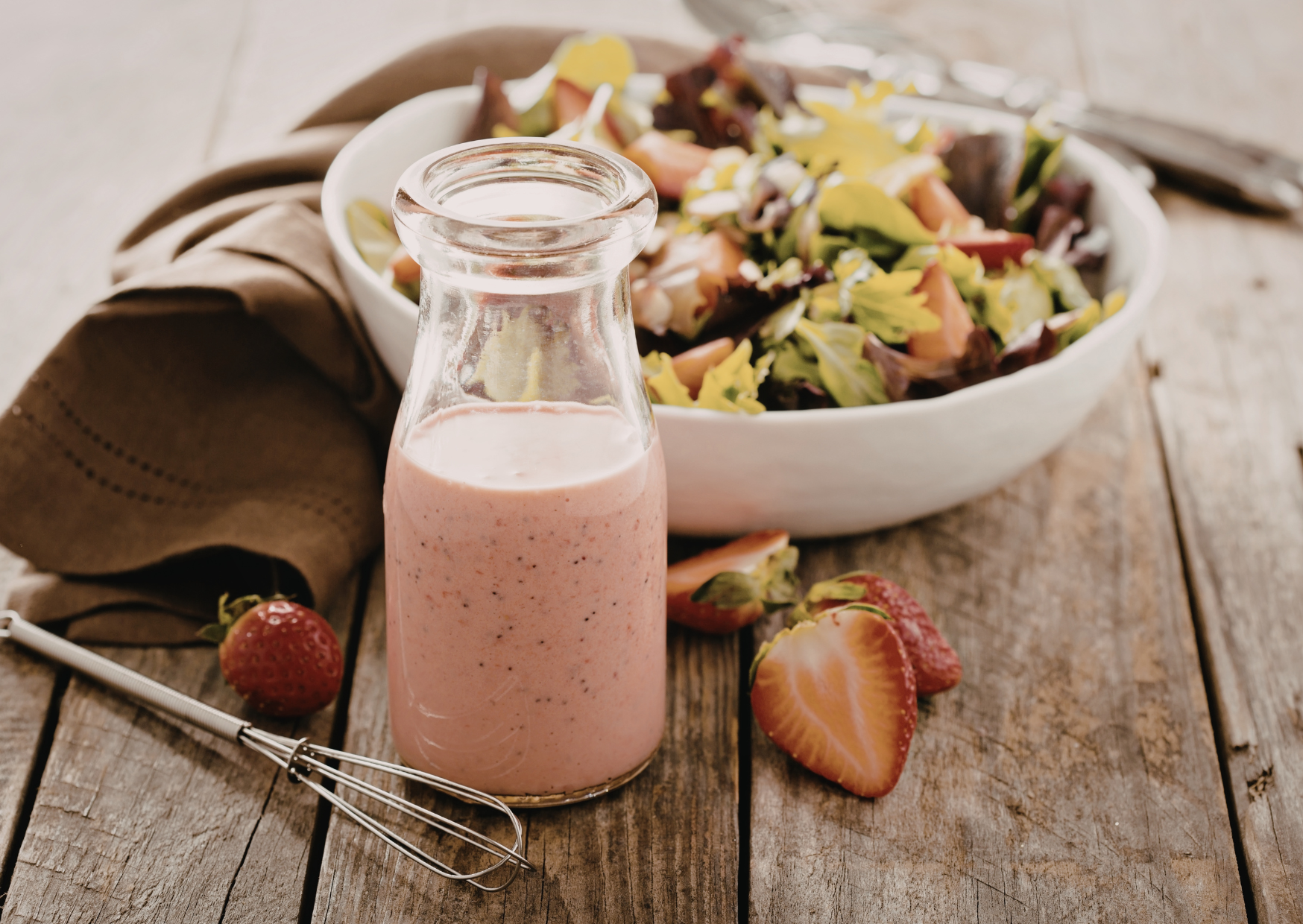
One reason people still care about this story is that the U.S. food supply got very good at hiding industrial trans fats in places consumers did not expect.
Not just the obvious junk.
Baked goods, crackers, frostings, coffee creamers, microwave products, margarine, and assorted processed sauces and dressings all benefited from the same manufacturing shortcuts. The European Commission’s trans-fat page is useful here because it treats industrial trans fat as a production issue tied to partially hydrogenated oils across processed foods, not as one niche ingredient in one category.
That is why salad dressing makes such a good example.
It is familiar. It is ordinary. It sits in the fridge for weeks. It is often sold as a wellness accessory to vegetables. And it used to be one more place where food engineering could smuggle in a harmful fat profile while the marketing smiled politely.
That is a very American trick.
Take a food people associate with health.
Wrap it in convenience.
Use industrial shortcuts.
Count on the consumer not reading too closely.
This is also why Europe’s stricter posture mattered. Once you tell manufacturers they cannot rely on industrial trans fats, they reformulate. The Danish experience and later EU rules show that industry can adapt when the rule is real enough.
The Real Issue Was Never Just One Bottle
It was the total daily load.
A person was not likely to get wrecked by one tablespoon of one dressing in isolation.
The problem was cumulative exposure.
Industrial trans fats could show up in enough little places that the day became a chemical patchwork of avoidable cardiovascular risk. OECD and WHO materials both emphasize that this is exactly why policy mattered. It was not enough to tell consumers to be more disciplined if the food environment itself was structured around cheap harmful fat inputs.
That is one of the reasons Denmark’s law mattered so much. It did not depend on perfect consumer behavior. It changed the baseline.
And that is one of the reasons the story still annoys Americans once they learn it. Because it reveals how long people were expected to self-defend against an ingredient problem that policy could have addressed more decisively.
What Europe Forced Companies to Do Instead
They had to reformulate.
That is the entire point of a serious ingredient restriction. Not to make scary headlines. To force the product itself to change.
Once industrial trans fats were capped or effectively banned, companies had to find other fat systems, other emulsification approaches, and other shelf-stability strategies. That did not magically make all processed food healthy. It did remove one clearly harmful shortcut from the toolbox. WHO’s 2025 recognition of countries with life-saving trans fat elimination policies is built on that exact logic: eliminate the industrial source and the food supply gets safer at scale.
This matters because Americans are often told food reformulation is impossible, too expensive, or somehow paternalistic.
The Danish case and later EU-wide regulation suggest otherwise.
The real lesson is not that Europe created perfect food.
It is that it was willing to remove a known bad input sooner and more systematically.
How to Read This in 2026 Without Turning It Into a Fake Purity Story
America has already pushed partially hydrogenated oils out of most of the food supply through FDA action. So the useful lesson is not “all American dressing still contains banned trans fat.” The useful lesson is that the regulatory timeline matters, food culture matters, and Europe was ahead on this problem in a way that still reveals something about how the two systems work.
And no, that does not mean every European bottled dressing is suddenly wholesome.
It means one known harmful fat source was legally pushed out earlier in parts of Europe and later across the EU. That is a meaningful public-health difference, not a civilization contest.
It also reminds people of something useful:
if a bottle has to last forever, taste identical at every temperature, cling to salad perfectly, and cost almost nothing, somebody is usually solving those demands with ingredients you should at least be curious about.
The Better Dressing Rule Is Still Boring
You do not need a complicated final lesson here.
Just a boring one that works.
If you are buying bottled dressing, read the label.
If the ingredient deck looks industrial, it probably is.
If you can make dressing from olive oil, vinegar or lemon, mustard, salt, and herbs, that is still the cleanest fix.
And if you are choosing between a dressing built around ordinary fats and one built around shelf-life wizardry, choose the first one.
The long European lesson was not “never eat sauce.”
It was “do not let a cheap industrial fat shortcut hide in a food people think is healthy.”
That is still a pretty good rule.

About the Author: Ruben, co-founder of Gamintraveler.com since 2014, is a seasoned traveler from Spain who has explored over 100 countries since 2009. Known for his extensive travel adventures across South America, Europe, the US, Australia, New Zealand, Asia, and Africa, Ruben combines his passion for adventurous yet sustainable living with his love for cycling, highlighted by his remarkable 5-month bicycle journey from Spain to Norway. He currently resides in Spain, where he continues sharing his travel experiences with his partner, Rachel, and their son, Han.