
It’s not that French hosts are magically calmer. It’s that the format is built to protect the host’s nervous system, even when the meal runs long.
The American Christmas hosting fantasy is a trap: the house looks perfect, the meal lands at one exact time, everyone is delighted, and the host is somehow relaxed in a clean outfit.
Reality is usually a sweaty kitchen, a sink full of knives, and one person doing emotional labor while everyone else “helps” by asking what they can do every five minutes.
France has plenty of intense holiday meals, but the hosting style often avoids the specific American failure mode: the meal that depends on one exhausted person pulling off five hot dishes at once.
The French approach is less “big reveal” and more “structured flow.” You start with an apéritif. You feed people early in small bites. You keep the main course simple. You let dessert be purchased without shame. You stretch the evening at the table instead of stretching the cook in the kitchen.
And yes, there’s a name for the big Christmas Eve dinner in France, le Réveillon. It often starts late, around 8 or 9 p.m., and traditionally includes multiple courses, often seafood or oysters, foie gras, a roasted bird, and a bûche de Noël.
You don’t need to copy the exact French menu to steal the French hosting calm. You need to copy the mechanics.
The French hosting goal is not abundance, it’s flow
American hosting often tries to prove love through volume. More food, more decor, more gifts, more everything, plus the pressure to make it look effortless.
French hosting, at its best, is trying to do something else: create a long, pleasant evening where the guests feel taken care of without the host becoming the casualty.
That sounds abstract, so here’s what it looks like in practice.
It looks like a table that starts early, even if dinner is late. People aren’t standing around hungry while you wrestle the oven. They’re drinking something small, nibbling something salty, and settling into the room.
It looks like a menu with fewer moving parts. French Christmas meals can be long, but they’re often linear: apéro, starter, main, cheese, dessert. That order matters because it lets you prep and serve in stages instead of trying to land everything at once.
It looks like permission to outsource. A bûche de Noël from a pâtisserie is normal. It’s not “cheating,” it’s part of the culture.
And it looks like the host staying present. Not because French hosts do less work, but because the work is front-loaded and simplified.
If you want to eliminate holiday stress, your first decision is not about recipes. It’s about what you’re optimizing for.
American hosting often optimizes for spectacle. The French model optimizes for a stable evening.
When you optimize for stability, you automatically make different choices:
- one centerpiece, not three
- make-ahead components
- food that holds
- a start that buys you time
- dessert that doesn’t ruin your day
This is why French hosting can feel calm even when the meal lasts hours. The length is at the table, not in the kitchen.
The apéro table is the stress killer Americans keep skipping
If you steal only one French move, steal this: apéro first.
Apéro is not an appetizer in the American sense. It’s not “a little snack before the main event.” It’s the bridge that transforms hosting from frantic to controlled.
Because once people are eating something, the whole room relaxes. The clock stops screaming. You stop trying to hit an exact minute. You get your hands back.
The apéro table also changes the psychology of the meal. In the U.S., people often arrive and immediately start assessing whether dinner is “ready.” In the French format, arrival is its own phase. Nobody expects a plated dinner the second they walk in.
So what goes on an apéro table that actually works?
Not a Pinterest grazing board that requires a knife set and a stylist. A French apéro table is often simple, salty, and repeatable:
- olives
- nuts
- sliced saucisson or charcuterie
- a small bowl of chips
- radishes with butter and salt if you want to be very French about it
- a simple pâté, or even a good spread and bread
- something briny, cornichons, pickles, anchovies
The job of apéro food is not to impress. It’s to buy you time and soften the room.
And there’s a hidden bonus: apéro protects you from overcooking the main. If dinner runs 20 minutes late, nobody cares. They’ve already eaten and they’re already happy.
French Christmas meals often begin with an apéritif phase before moving into the courses.
If you’re hosting in the U.S. and you want to copy this without feeling like you’re pretending to be French, just call it “drinks and snacks.” But treat it like a real part of the plan, not an afterthought.
A practical apéro rule that saves your sanity: everything must be serveable in 10 minutes. If it needs cooking, it doesn’t belong in apéro.
When you do apéro properly, the meal stops being a sprint. It becomes a sequence.
French Christmas menus are long, but they’re not chaotic
Americans hear “multiple courses” and imagine more work. Sometimes it is more work. But the French advantage is that each course is usually simpler than an American buffet spread.
The American holiday pattern often stacks complexity sideways: turkey, stuffing, potatoes, gravy, green beans, rolls, cranberry sauce, mac and cheese, plus two appetizers, plus dessert. Everything is “main-sized.”
The French pattern stacks it vertically: a small starter, one main, cheese, dessert. The total experience feels rich, but you’re not juggling eight hot dishes at once.
A traditional Réveillon menu is often described as a sequence of courses, commonly including oysters or seafood, foie gras, a roasted bird, then dessert like bûche de Noël.
You don’t need foie gras or oysters to use the structure. You just need one clear centerpiece and sides that don’t require constant attention.
Here are three “French-structured” Christmas menus that are realistic and calm. Choose one lane.
Lane 1: The elegant minimal
- Apéro snacks
- Starter: simple salad with a sharp vinaigrette
- Main: roast chicken or capon-style bird, one pan, one sauce
- Cheese plate
- Dessert: purchased bûche or a good tart
Lane 2: The seafood-forward
- Apéro snacks
- Starter: oysters, or smoked salmon with lemon
- Main: fish in the oven with butter and herbs, plus potatoes
- Cheese
- Dessert: purchased
Lane 3: The cozy winter
- Apéro snacks
- Starter: soup you made earlier
- Main: beef or pork roast that can rest
- Cheese
- Dessert: purchased
Notice what’s missing: five sides that all need the stove at once.
The French menu logic is that each phase has one job:
- apéro keeps people happy
- starter signals the holiday
- main provides substance
- cheese stretches the table
- dessert ends the night without extra labor
The meal is long, the cooking stays contained. That’s the stress eliminator.
The French “host gift” rule is real, and it changes the vibe

Another small structural difference: in France, it’s common to bring something when you’re invited to someone’s home.
That doesn’t mean guests show up with casseroles like American potlucks. It usually means a small gift that respects the host: flowers, chocolates, a bottle, something thoughtful.
Multiple etiquette guides aimed at France make this point clearly, bring a small gift when invited, and common safe choices include flowers, chocolates, and wine.
There’s also a nuance Americans get wrong: some French etiquette discussions note that bringing wine can be tricky because the host may already have planned pairings, so wine is not always the “best” default unless you know the household.
The reason this matters for stress is not the gift itself. It’s the social contract.
In the U.S., the host often carries the whole burden and guests arrive empty-handed because “they’re a guest.” In the French model, the guest arrives as a participant. That softens the load emotionally, even if the host still did most of the work.
If you want to steal this in America, you don’t need to lecture people about etiquette. You just set the tone.
You do it with one line in the invite:
- “If you feel like bringing something, bring chocolates, flowers, or a bottle for after dinner.”
That last part is important. “For after dinner” removes the wine pairing pressure and still makes the guest feel useful.
Shared responsibility reduces resentment. That’s a very adult holiday upgrade.
And if you’re the guest, here’s the easiest version that never annoys anyone:
- something consumable
- something that doesn’t create work right now
- something that can be enjoyed later
Coffee, jam, chocolates, a small box from a bakery. It’s the same logic Ina Garten mentions in a U.S. context too, gifts for the day after can be more respectful than adding pressure in the moment.
The French dessert “cheat” is the whole point
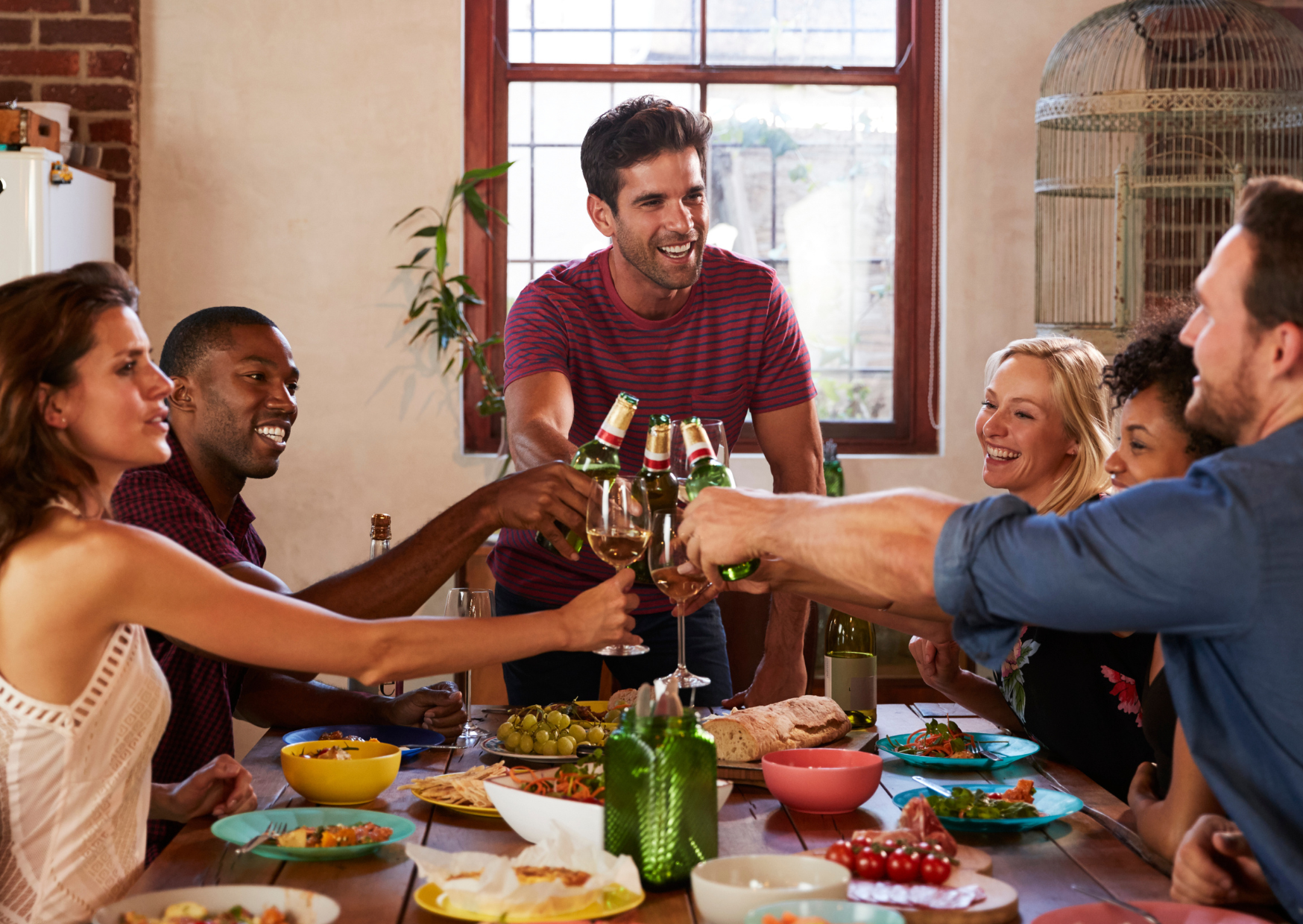
Americans treat dessert like a second performance.
You already cooked dinner, now you’re supposed to bake something, plate it beautifully, and serve it while pretending you’re not exhausted. This is how people end up making December feel like a job.
French hosting quietly refuses this.
Yes, people bake in France. Yes, there are incredible home bakers. But buying the dessert is normal, especially for Christmas. The bûche de Noël is iconic, and plenty of households simply buy it.
That choice does two things:
- it saves time
- it saves mental energy
And mental energy is the real scarcity during the holidays.
If you want a French-feeling finish without stress, do this:
- one purchased dessert
- coffee
- fruit on the table
- and then sit down
This is where the French pacing shows up again. Dessert isn’t a rushed finale. It’s a long landing.
If you’re hosting and you want the night to feel calm, protect the last hour. Don’t spend it plating. Spend it sitting.
A practical “French dessert rule” that works in any country: dessert must require zero last-minute cooking. If it needs baking at 9 p.m., it’s not a calm host dessert.
Buy the bûche. Buy the tart. Buy good cookies. Then put your energy where it actually matters, being in the room.
The clock works differently in France, and you should copy that too
A lot of American hosting stress comes from pretending dinner has a sharp start time.
The French Réveillon is often described as a late evening meal that can last for hours. That alone changes the rhythm. Late meals naturally invite a slower buildup.
But even if you’re not eating at 9 p.m., you can copy the time logic:
- invite people for a window
- feed them something immediately
- serve the main when it’s ready, not when the schedule says it should be ready
This is not sloppy. It’s strategic.
If you want to eliminate holiday stress, stop designing your menu around one perfect minute.
Design it around a range:
- apéro begins when the first guests arrive
- starter happens when most people are present
- main happens when it’s cooked and rested
- cheese and dessert stretch the night
Rest time is part of the schedule, not an inconvenience. This is where American hosts mess up roasts, they rush the rest because they feel pressure, then everything feels drier and more frantic.
When you build rest into the plan, you stop hovering.
Also, a small but real hosting upgrade from the French style: don’t overheat the room. French Christmas meals are long, and the table is where people sit for ages. Keeping the room comfortable matters more than fancy centerpieces.
If you want your guests to stay, lower the temperature a little, light the candles, keep the table stocked with water, and stop turning the kitchen into a sauna.
That’s the kind of boring detail that makes the night feel elegant.
A French-style 7-day hosting plan you can actually run
This is the part to screenshot. Not because it’s cute, because it works.
Day 1: Choose the structure
Pick your lane and lock the menu. Apéro, starter, one main, cheese, dessert. One main only.
Day 2: Build your apéro list
Write 6 apéro items, all no-cook. Buy what you can now. Put it in one box in the fridge.
Day 3: Decide what you will buy
Dessert is purchased. Cheese is purchased. Bread is purchased. Give yourself the gift of outsourcing.
Day 4: Make anything that improves overnight
Soup, sauces, vinaigrette, roasted nuts, anything that tastes better later. Make it now.
Day 5: Set the table early
This sounds small, but it changes your mood. When the table is done, you stop feeling behind.
Day 6: Confirm the arrival window
Text guests the truth: “Come anytime between 6:30 and 7:15.” You’re not running a restaurant. You’re setting a calm expectation.
Day 7: Cook the main, then stop
Apéro goes out immediately. Starter is simple. Main rests properly. Dessert is already done because you bought it. Then you sit down.
And if something goes wrong, and something always does, the French format contains the damage. If the main is late, apéro carries you. If the starter is smaller than planned, cheese fixes it. If dessert is boring, coffee and fruit still land.
Redundancy is calm. That’s what the French structure gives you.
At the end of the night, the question is not “did I impress everyone.” The question is “did I get to be there.”
American hosting often sacrifices the host for the holiday.
The French approach, when it’s done well, protects the host and still feels festive. That’s the version worth stealing.

About the Author: Ruben, co-founder of Gamintraveler.com since 2014, is a seasoned traveler from Spain who has explored over 100 countries since 2009. Known for his extensive travel adventures across South America, Europe, the US, Australia, New Zealand, Asia, and Africa, Ruben combines his passion for adventurous yet sustainable living with his love for cycling, highlighted by his remarkable 5-month bicycle journey from Spain to Norway. He currently resides in Spain, where he continues sharing his travel experiences with his partner, Rachel, and their son, Han.