
You breeze to the gate with a $39 fare, a tiny suitcase, and American instincts. Security said nothing, so you assume you’re fine. Then the agent points to the metal frame. Your bag rides the sizer like a stubborn mule, the wheels catch, and a card machine appears. The “cheap” ticket is now an add-on, a gate fee, and a lesson you’ll never forget.
Here’s the quiet truth of Europe’s low-cost carriers: overhead space is paywalled, under-seat size is the only free constant, and enforcement happens at the gate, not at security. If you know that, you’ll fly for pennies. If you don’t, you’ll fund the airline’s quarterly results.
Want More Deep Dives into Other Cultures?
– Why Europeans Walk Everywhere (And Americans Should Too)
– How Europeans Actually Afford Living in Cities Without Six-Figure Salaries
– 9 ‘Luxury’ Items in America That Europeans Consider Basic Necessities
Quick Easy Tips
Always check the baggage policy before booking a flight.
Measure your bag and make sure it meets the personal item size limits if you want to avoid fees.
If you need extra luggage, book it online in advance—it’s almost always cheaper than at the airport.
Pack light and smart to minimize the need for carry-ons.
Consider paying slightly more for a fare that includes a carry-on if it’s cheaper than surprise airport charges.
Budget airlines thrive on offering low base fares and then making up the difference with add-on fees. Critics argue that this business model is intentionally deceptive, luring travelers in with prices that seem too good to be true. Many inexperienced travelers don’t realize that the “cheap” flight often costs just as much as a regular airline once all the extras are added.
On the other hand, defenders of budget airlines point out that the rules are clearly stated for anyone who takes the time to read them. They argue that these airlines give travelers a choice: pay for exactly what you need and nothing more. For seasoned travelers who pack light and plan ahead, this can still mean a genuinely low fare.
The controversy highlights a bigger divide in travel expectations. In the U.S., carry-on luggage is typically included, so many travelers assume the same applies in Europe. That cultural gap in travel habits is exactly why so many Americans are caught off guard by what they see as “hidden” fees—when in reality, they’re just playing by a different set of rules.
What “carry-on” really means in Europe
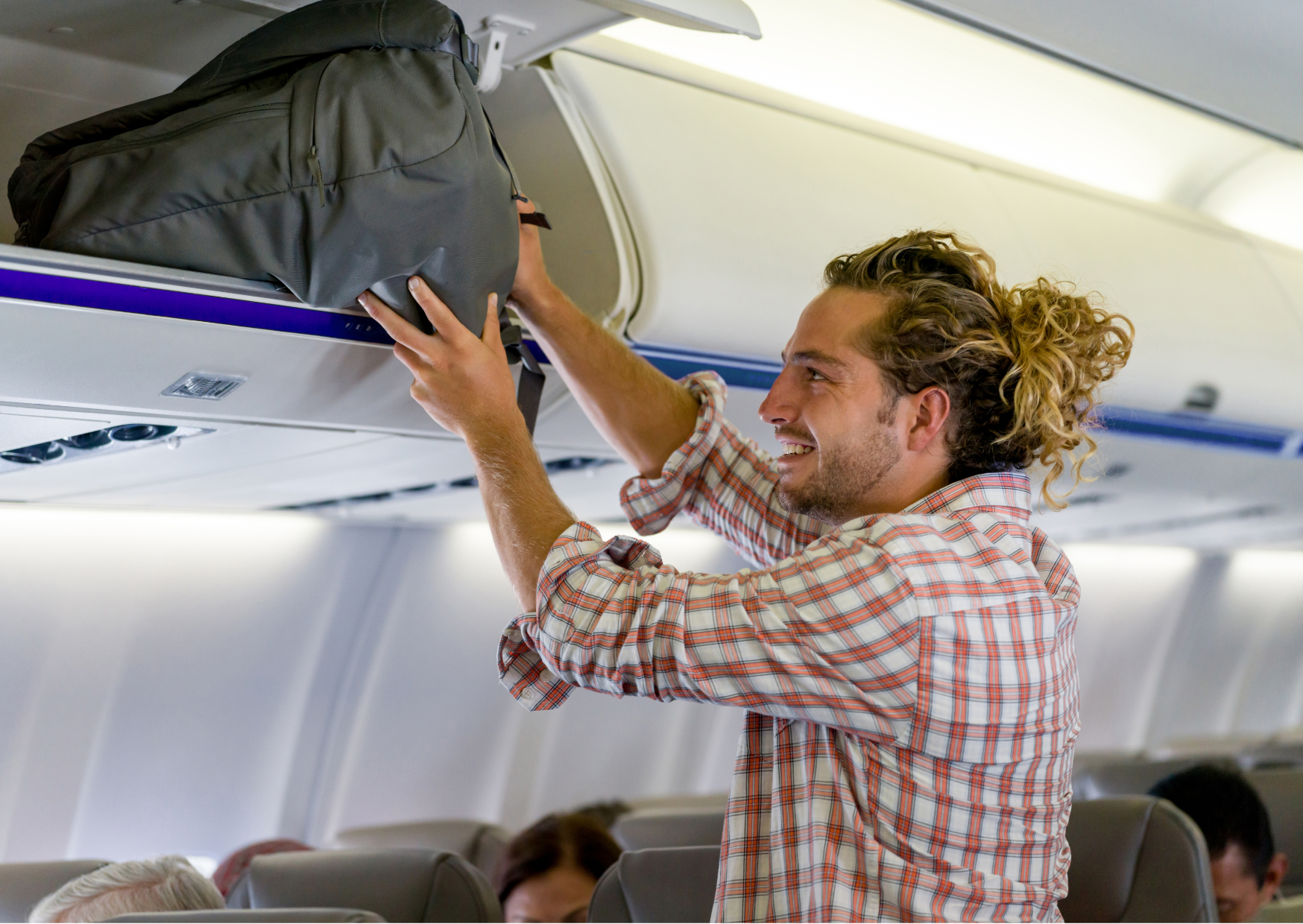
On Europe’s budget airlines, the fare includes one small under-seat bag—not a roller, not a “regular carry-on,” and not “whatever fits if you smile.” Anything for the overhead bin is a paid product tied to your booking or your seat type.
Three realities to internalize: overhead = add-on, wheels count, gate checks are intentional. You’re not being singled out; you’re meeting a business model that sells the bin above your head the way hotels sell late checkout. Accept that design and you instantly stop paying “surprise” fees.
The big-five snapshot (so you stop guessing)
Ryanair. Free: one small under-seat bag. As of early August 2025, Ryanair announced it’s increasing the free bag to 40 × 30 × 20 cm (up from 40 × 20 × 25), with sizers being updated “over the next weeks.” Until your airport’s sizer changes, assume the smaller frame. The paid path is Priority & 2 Cabin Bags—you keep the small bag and add a 10 kg overhead bag 55 × 40 × 20 cm. Measure to the centimeter, including handles and wheels.
easyJet. Free: one under-seat bag 45 × 36 × 20 cm—and easyJet explicitly says up to 15 kg, as long as you can lift it. To use the overhead, buy a Large Cabin Bag (56 × 45 × 25) via an “Up Front/Extra Legroom” seat or as an add-on. Under-seat is generous in volume; dimensions still rule.
Wizz Air. Free: one 40 × 30 × 20 under-seat bag. Overhead access comes with WIZZ Priority, adding a 10 kg trolley 55 × 40 × 23. No Priority, no overhead.
Vueling. Base fares include only the under-seat bag (site shows 40 × 30 × 20); the 10 kg overhead bag 55 × 40 × 20 is an add-on or part of certain bundles. Gate oversize is expensive.
Eurowings. BASIC includes a 40 × 30 × 25 under-seat bag; a 55 × 40 × 23 (8 kg) overhead bag is part of upgrades or purchasable. Weight caps exist here—8 kg means 8.
Read that again and circle the bold bits: under-seat is free, overhead is a product, dimensions are non-negotiable. That’s the difference between “steal” and “sting.”
Where a $39 fare becomes $189
The jump isn’t magic—it’s mis-timed purchases. Buy the overhead bag in-app during booking and you’ll pay the lowest price. Wait until the airport and you’ll pay the day-of rate or a gate fee. Two concrete examples:
- easyJet: bring a non-purchased overhead bag to the gate and expect a flat gate fee (about £48) plus your bag goes in the hold. Pre-buying costs far less.
- Vueling: an under-seat bag that’s too big at the gate incurs €60–€75; an oversized overhead bag triggers €110–€140—per item, per flight. That’s how roundtrips spiral.
Ryanair’s fees vary by route and product, but the pattern is the same: oversize at the gate is the most expensive moment in aviation. Media and analysts peg that hit at roughly £70; Ryanair’s fee page confirms oversize bags may be refused or routed to the hold with a charge. Don’t test the frame.
Why security says nothing—and the gate says everything
Airport security checks safety, not your contract. The person who cares about your dimensions is the handler at the gate, often employed by a ground-services firm on a checklist and KPI. In the UK, reporting in July 2025 showed staff paid bonuses for catching oversized easyJet bags—proof that enforcement is intentional, not “mean.” Expect the sizer; expect the scale; expect consistency.
The only three measurements that matter
Tape your bag like you’d tape a moving box. Length, width, depth—with wheels/handles—must fit the airline’s rectangle. Soft bags are forgiving; hard shells are not. On carriers with weight caps (Eurowings 8 kg; some Wizz/easyJet products for overhead), pack to the lowest number on your itinerary. Dimensions beat vibes every time.
The legal free extra you can carry (that no one uses smartly)
Most carriers allow one standard duty-free shopping bag in addition to your cabin allowance. It’s not a hack; it’s in the terms. This helps when you bought a bottle or snacks after security and don’t want to cram them into a brick-full under-seat bag. Keep it modest, keep the receipt, keep it tidy—and don’t try to rebrand a second backpack as “duty-free.”
Your booking strategy (buy the bin, not the drama)
Design your itinerary around the tightest segment—usually the short hop on a low-cost carrier. Then:
- Decide overhead access now. If you’ll truly need it, buy Priority/overhead at booking for both legs. It’s cheaper than “I’ll see at the gate.” Early equals economy.
- Match seat to bag. On easyJet, adding a Large Cabin Bag pairs naturally with Up Front or Extra Legroom. On Ryanair/Wizz, Priority is the product name you want. Product names matter.
- Mirror your return. If you needed overhead outbound, you’ll need it back. Most “surprises” happen on the flight home when the return airport enforces harder.
This isn’t spending more—it’s spending right. You’re buying the space you plan to use, not an argument at a metal frame.
Your packing strategy (win the sizer in your living room)
Build around one under-seat bag that you know fits the strictest carrier you fly. Then:
- Choose soft-sided over hard shell; soft compresses into frames. Soft bags survive sizers.
- Keep the front pocket flat; bulges lose sizers. Flat fronts pass frames.
- Wear bulky layers on your body and move small dense items (chargers, power bank) to jacket pockets for boarding, then stow after takeoff. Mass on you, not on the bag.
If you add overhead access, keep that bag under 10 kg on carriers that weigh (Ryanair’s 10 kg product; Wizz 10 kg trolley). On Eurowings, 8 kg is your cap. Weight limits are real.
Connections and mixed tickets (the trap few see coming)
You might fly a generous long-haul into Europe, then connect to a low-cost hop. The second airline’s rules control the second flight. Your roller that sailed through JFK suddenly fails in Milan. If your booking isn’t a protected through-ticket, no one will smooth this out at the airport.
Fix it in the cart: treat the short-haul as its own trip. Buy the overhead product if needed and pack to that carrier’s dimensions. The tightest rule wins. Always.
What to do if you’re flagged at the gate
Stay calm. Ask for the cheapest compliant option: “Can I pay the gate fee to check this?” You’ll usually be charged a flat amount and your bag goes to the hold. Remove batteries, passports, laptops, meds—they must stay with you. The fee stings, but the fight burns time and rarely wins. If this is leg one of two today, ask if the fee covers both sectors (usually no; it’s per flight).
Then fix it for the return in the app the minute you sit down: buy the overhead product or repack to the under-seat frame. That five-minute pivot saves you from paying twice.
Sundays, scales, and who gets weighed
Do under-seat bags get weighed? Sometimes. easyJet lists up to 15 kg on the under-seat item—oddly generous—and many airports don’t bother weighing small bags if they fit cleanly. But if the bag looks heavy or deformed, they can weigh it. On Eurowings and some Wizz products, weight checks are more common on the overhead item. Don’t gamble on “they never check.”
2025 changes you should actually care about
Two threads matter this year:
- Ryanair’s free-bag size increase. Announced in August 2025, moving to 40 × 30 × 20. It’s a real improvement, but sizers roll out gradually. Until you see the new frame, pack to the old one to avoid “computer says no.”
- EU harmonization noise. Lawmakers are pushing for a standard free hand-luggage size across EU carriers. It’s politics, not airport reality—policies vary today, and the gate frame still rules. Follow the airline’s posted numbers, not the headline.
Families, strollers, and special cases (keep it simple)
Most carriers let you take baby equipment (stroller, car seat) with special handling; rules vary by airline and route. If you’re traveling with infants or medical gear, check your carrier’s page before you fly and print the relevant line. At the gate, paper beats debate. Special items are exceptions—not loopholes.
The five-minute pre-trip audit (do this before you pack)

Pick the ruler. Choose the strictest carrier on your itinerary and build to that under-seat size. Tightest rule first.
Decide overhead yes/no. If yes, buy it now in the app for both legs. Early buy = lowest price.
Weigh and test. Fill your bag and test-fit in a home frame (cardboard to dimensions). Hit 8–10 kg for overhead items where weight applies. Home sizer beats airport sizer.
Plan the duty-free. If you’ll shop airside, keep it to one standard bag with receipt. Duty-free is a permitted extra, not a second backpack.
Screenshot the rules. Save the airline’s dimensions page to your phone. If a handler misstates a number, you have the current policy in your pocket. Screenshots save fees.
Putting it in perspective
Low fares aren’t a trap; they’re a contract. Europe’s budget airlines are transparent—if you read the box you ticked. The overhead bin is a product you either buy or you don’t. The under-seat bag is the floor everyone gets for free. The gate teams are paid to enforce the line. Once you move with that rhythm, the $39 fare stays $39—and your bag stays with you.
Fly the model, not the myth: buy the space you’ll use, pack to the rectangle, walk past the sizer with a smile. Do that, and the only lesson you’ll take home is how embarrassingly cheap Europe can be when you stop paying the gate.
Final Thoughts
Cheap flights across Europe often seem like a dream come true, especially for travelers used to higher fares in United States. But those enticing $39 tickets on budget airlines come with a catch that many people don’t realize until it’s too late: the carry-on rule. What looks like a bargain can quickly snowball into a much more expensive trip if you don’t read the fine print.
Most budget airlines have strict baggage policies that are very different from what many travelers are used to. A small personal item may be included, but a standard-sized carry-on often comes with a hefty extra fee if not pre-booked. At the airport, that fee can skyrocket, turning a cheap getaway into a costly lesson.
The key takeaway isn’t to avoid budget airlines but to outsmart their policies. By understanding the rules in advance and planning accordingly, travelers can still enjoy those low fares without falling for the most common trap.

About the Author: Ruben, co-founder of Gamintraveler.com since 2014, is a seasoned traveler from Spain who has explored over 100 countries since 2009. Known for his extensive travel adventures across South America, Europe, the US, Australia, New Zealand, Asia, and Africa, Ruben combines his passion for adventurous yet sustainable living with his love for cycling, highlighted by his remarkable 5-month bicycle journey from Spain to Norway. He currently resides in Spain, where he continues sharing his travel experiences with his partner, Rachel, and their son, Han.