

It’s not “Italy being strict.” It’s you walking into an active place of worship dressed like it’s a beach club and expecting the building to adapt.
It usually happens in the heat.
You’ve been walking for hours. Your phone says 33°C. The streets are glossy with tourists and gelato, and everyone is quietly melting. You finally reach the church you’ve been aiming at all morning, the one you saved on your map with five stars and a little heart because you promised yourself you’d stop doing “Italy highlights” like a sprint.
And then, right at the entrance, you see the sign. The little cartoon bodies. The crossed-out shoulders. The crossed-out shorts. The crossed-out miniskirt.
You look down and realize you’re wearing exactly what the sign is warning against.
A sleeveless top. Bare shoulders. Shorts above the knee. Maybe a sundress with thin straps. Something that is perfectly normal in an American summer and perfectly normal on an Italian street and suddenly very not normal at the door of a church.
This is the part Americans find insulting. “It’s 2025.” “It’s a tourist site.” “I paid for a ticket.” “My outfit is fine.”
None of that matters. In Italy, many major churches are not “tourist sites” that happen to be old. They are churches that happen to be famous. The order matters.
So yes, you can absolutely be turned away. Not yelled at. Not shamed. Just blocked. You’ll stand there awkwardly while someone behind you walks in smoothly because they wore linen trousers instead of tiny shorts.
And if you’re traveling as a family or a couple, it gets worse because you’re suddenly negotiating who goes in, who waits outside, and whether you want to waste another hour hunting for a scarf in the sun.
Here’s what “this” really means, how the rules actually show up at big-name churches, and how to never lose time to it again.
The outfit that gets you stopped is not sexy, it’s “too much skin”

Let’s be specific, because vague advice like “dress modestly” is how people end up standing outside the Duomo like they’re being punished.
The two triggers you see over and over are uncovered shoulders and uncovered knees.
That’s the core.
Everything else is just variations on that theme.
What commonly gets flagged at the door:
- Tank tops and camisoles, especially thin straps
- Strapless tops and bandeau styles
- Short shorts and most athletic shorts
- Miniskirts and many above-knee dresses
- Low-cut tops and backless styles
- Crop tops and anything showing midriff
- Beachwear, see-through cover-ups, and the “I just came from the sea” look
- Hats inside, especially for men in many places
And no, it’s not only women. Men get stopped too. A sleeveless muscle shirt on a guy is basically a guaranteed fail in the stricter spots. It’s not gendered fairness, it’s the building’s decorum rules.
Americans also miss a subtle detail: some places care about “knee coverage” more than “shorts vs no shorts.” Long shorts that actually hit the knee can pass. Shorts that sit mid-thigh usually will not.
The other thing that gets people is the mismatch between street and doorway. Outside, Italy in summer is casual. You’ll see short dresses everywhere. You’ll see shoulders everywhere. You’ll see people dressed beautifully, and also people dressed like they gave up.
But when you step into a church, especially a major one, the expectations snap back to a more conservative standard.
It’s not about you being “improper.” It’s about you being in the wrong uniform for the room.
Why Italians treat this as obvious and Americans treat it as offensive
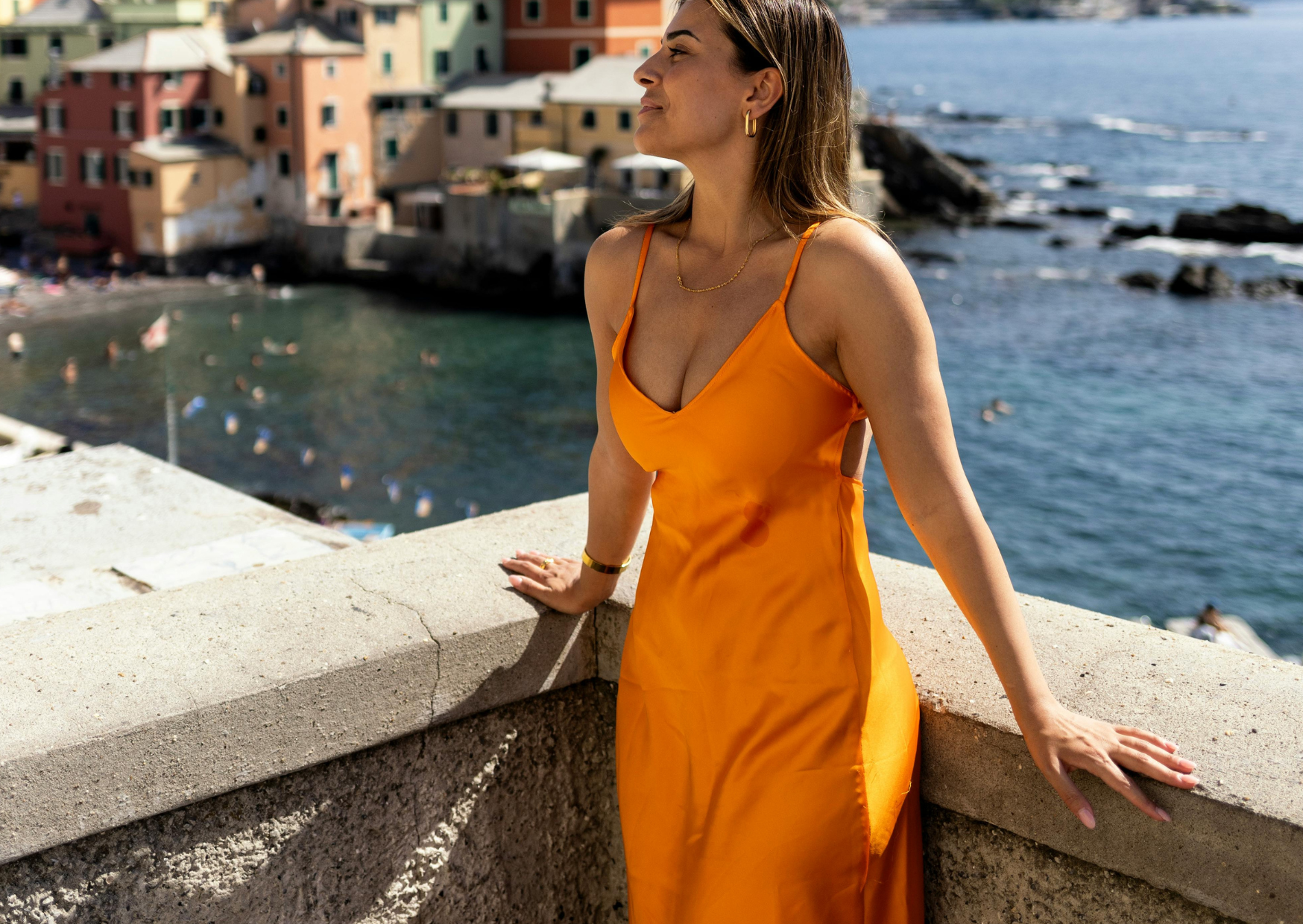
This is a culture clash dressed up as a clothing problem.
Americans are used to a certain logic: if a place sells tickets and handles crowds, it’s a tourist attraction first. Dress codes feel like arbitrary power.
Italian churches, especially famous ones, run on a different logic: the building is sacred first, and crowds are a side effect. A dress code is not “management being annoying.” It’s protecting the tone of the space.
That sounds lofty, but it’s also practical.
Churches in Italy are not museums where the vibe is “do what you want as long as you don’t touch the art.” Churches are spaces where people pray, light candles, attend mass, grieve, and sit quietly even in the middle of tourist chaos. If you’ve ever stepped into an Italian church on a hot day, you’ve felt it. The temperature drops. The noise drops. Your voice drops automatically.
When someone walks in dressed like they’re about to order a spritz at a beach club, it breaks that atmosphere. Not because the outfit is immoral. Because it’s the wrong signal for the setting.
Also, Italians tend to have a strong sense of “read the room.” You don’t wear the same thing to the beach, the office, and church. That’s not a religious statement. It’s a social one.
This is where Americans get trapped. In the U.S., casual dress rules have expanded so far that “casual” can mean almost anything. In Italy, casual still has boundaries in certain spaces, and church is one of them.
If you want a simple way to understand it: Italians may dress casually, but they don’t always dress context-blind.
And the enforcement is not personal. The person at the door is not judging your character. They’re enforcing a standard that applies to everyone, including Italian visitors who show up in short shorts because it’s hot.
Nobody gets a special pass because they flew far, paid a ticket, or have a strong opinion about shoulders.
The actual rules at major sites are surprisingly blunt

The mistake Americans make is assuming every church is different and the rules are fuzzy. In many major places, the rules are printed, posted, and repeated so often that staff can enforce them in their sleep.
Here are three big examples that show the pattern clearly:
St. Peter’s Basilica (Vatican City)
The Basilica’s own FAQ states that shoulders and knees must be covered for both men and women. That’s the whole rule in one sentence, and it’s one of the most enforced doors in Europe.
Vatican Museums and Sistine Chapel
The Vatican Museums’ official visitor guidance is even more detailed: sleeveless or low-cut garments, shorts above the knee, miniskirts, and hats are not permitted. It also extends “decorum” to visible signs or objects that may offend Catholic morality or religion, including things like certain tattoos.
Milan Duomo
The official rules document for the Milan Duomo complex states that visitors must be dressed appropriately, and it explicitly bans sleeveless or low-cut clothing, shorts, miniskirts, and hats inside the cathedral.
Notice what’s consistent: cover shoulders, cover knees, and don’t show up in beachwear.
Now, the real-world detail people care about: enforcement varies by location and day. Sometimes a smaller church is relaxed. Sometimes a guard is strict. Sometimes a place is too busy to police every hemline. Sometimes they suddenly decide today is a “hard no” day.
That variability is exactly why you should not gamble.
If a church is on your must-see list, dress like someone who wants to get in on the first try.
The American mistakes that create the “turned away” moment
This is where you can save yourself a lot of unnecessary irritation.
Mistake 1: Dressing for the weather, not the doorway
Italy in summer makes people strip down. Fair. But the church door does not care that it’s hot. Heat is not an exemption.
Mistake 2: Assuming “tourist site” means “tourist rules”
You’ll hear Americans say, “It’s basically a museum.” In Italy, that logic is backward. Many churches are active worship spaces that allow tourists in, not the other way around.
Mistake 3: Thinking a tiny scarf is a fix for everything
A thin fashion scarf can help with shoulders. It does nothing for knees. And in a crowded entrance, fumbling with a scarf while people squeeze past is how you become a small public spectacle.
Mistake 4: Wearing athletic shorts as “practical travel clothes”
Americans love travel athleisure. Italy loves style, yes, but this is not about style. Athletic shorts are often too short and read as “gym” or “beach,” which is exactly what gets flagged.
Mistake 5: Getting righteous at the guard
Arguing feels satisfying for seven seconds. Then you realize you are still outside, and your family is sweating, and you’ve just turned a simple fix into a mood. The guard cannot rewrite the policy.
Mistake 6: Underestimating the hat rule
In many churches, hats indoors are not welcome, and men in particular are expected to remove them. If you’re wearing a cap for sun protection, fine, just be ready to take it off without drama.
Mistake 7: Treating it like a sexism issue in the moment
There are real conversations to have about modesty codes and gender. The doorway is not the place to have them. The door staff is enforcing a posted rule, and you will not win a philosophical debate fast enough to catch your entry slot.
The unsexy truth is that most “turned away” stories are preventable with one boring item in your bag.
The cheap fix is a cover-up kit, not a new wardrobe

You do not need to dress like you’re going to a wedding.
You need portable compliance.
If you’re traveling in Italy from late spring to early autumn, build a small kit that lives in your day bag. This is the part experienced travelers do without thinking.
The kit:
- A lightweight scarf or pashmina big enough to cover shoulders, not a tiny neck accessory
- A thin overshirt or linen button-up you can throw on over anything
- A midi skirt you can pull on over shorts, or lightweight trousers if you prefer
- For men, a breathable short-sleeve shirt with actual sleeves, not a tank
- Shoes that are normal for walking, because you will be walking, a lot
This is not about fashion. It’s about avoiding wasted time.
If you forget the kit, you end up doing the classic tourist scramble: buying an overpriced scarf from a vendor outside, or accepting a paper or plastic cover-up if the site offers them, or changing your entire day plan.
Also, the kit saves you from the worst version of the experience: one person is dressed “fine,” the other isn’t, and now you’re negotiating whether to split up.
If you’re traveling as a couple, agree on the rule early: either both of you can enter, or neither. It prevents resentment and it keeps the day calm.
And if you’re traveling with teens, assume they will dress for comfort and trend, and you will be the person carrying the backup plan. That’s just reality.
What to do if you get stopped, without making it worse
This is the part nobody tells you, and it matters more than you’d think.
If a guard stops you, the goal is not to prove you’re right. The goal is to get inside or to pivot cleanly.
Do this:
- Pause, listen, and don’t perform confusion
Even if you feel annoyed, keep your face neutral. No eye-rolls, no “seriously?” - Show the cover-up immediately
Take out the scarf or overshirt like you’ve done this before. Because ideally, you have. - If it’s knees, don’t try to negotiate with “but they’re almost knee-length”
If your shorts are clearly above the knee, you’re not going to talk your way into a different hemline. - If you need to buy something, buy it fast and move on
This is not the moment to bargain aggressively or rant about tourists being exploited. You’re buying time. - Keep your voice down inside
Even after you get in, Americans often get clocked by volume. Italian churches amplify sound. Whisper-level is safer. - Respect the “this is still a church” rules
No eating, no loud phone calls, no flash photography in places where it’s prohibited, no dramatic posing for photos during mass.
There’s a quiet dignity to doing this properly. You’re a guest in someone else’s sacred space. When you move like you understand that, the whole visit feels better.
And honestly, it changes how Italians treat you. People notice when you’re not acting like the building exists only for your content.
The deeper reason this keeps happening is vacation brain
Here’s the thing that doesn’t get said out loud: a lot of Americans struggle with church dress codes in Italy because they’re running on vacation logic.
Vacation logic says:
- Comfort first
- I paid, so I deserve
- Rules are for other people
- If I’m polite, I can negotiate exceptions
Italian church logic says:
- Respect first
- The rules are posted, so follow them
- The building is not yours
- Politeness is expected, not a bargaining chip
That clash is why this topic gets emotional.
When Americans hear “cover your shoulders,” they sometimes hear “you are being judged.” When Italians enforce “cover your shoulders,” they’re often thinking “this is a church, obviously.”
Also, Italy has layers. Italians can be relaxed about many things and strict about a few. Dress inside churches is one of the “few.”
The irony is that once you stop fighting this, it becomes easy. You stop seeing it as a moral statement and start seeing it as a basic entry requirement, like a ticket or a security check.
There’s also a practical bonus: churches are cool inside. Covering up is not always suffering. A light linen layer can actually feel better than sunburned shoulders and sweaty skin on stone benches.
So yes, the rule can feel old-fashioned. But it’s also not hard to meet. The hardest part is dropping the American instinct to treat every restriction as negotiable.
Your first 7 days in Italy: pack so you never get blocked again
If you want a simple plan that doesn’t require overthinking, do this before you travel, or in the first week of your trip.
Day 1: Identify your “must-enter” churches
If St. Peter’s, the Duomo in Milan, or any major basilica is on your list, assume strict enforcement.
Day 2: Choose your default “church-ready” outfit
Something you can wear on travel days and sightseeing days: a top with sleeves, and bottoms that cover the knee. Linen trousers are popular for a reason.
Day 3: Build the day-bag kit
A real scarf, not decorative. A light overshirt. If you wear shorts, pack a pull-on midi skirt or pack trousers and change if needed. Carry the fix.
Day 4: Practice the quick switch
Can you cover shoulders in ten seconds? Can you cover knees without a bathroom? If the answer is no, your kit needs work.
Day 5: Set the family rule
Everyone complies or everyone skips. No splitting the group because one person wanted to wear a crop top in July.
Day 6: Time your church visits
Go early if you can. Less heat, less crowd pressure, less chaos at the door when you’re trying to adjust clothing.
Day 7: Decide what matters more
If the church interior matters to you, dress for it. If dressing for it feels unbearable, accept you might be doing exteriors only. What does not work is pretending the door will bend to your mood.
This is the difference between a smooth Italy trip and one where you’re constantly irritated at “rules.” Italy has rules. You can either learn them or spend your vacation arguing with stone walls.
The choice is simple: be comfortable on the street, or comfortable at the door
You can absolutely walk around Italy in tiny shorts and a tank top. Many people do. Nobody is arresting you. Nobody is shocked.
But if you want to enter major churches without friction, you need to dress for the doorway, not the sidewalk.
That’s the whole reality check.
You can treat that as unfair and spend your trip getting blocked, improvising cover-ups, and feeling judged.
Or you can pack one scarf, choose one smarter outfit on church days, and move through Italy like someone who understands that some spaces still mean something.
It’s not about being modest. It’s about being competent.

About the Author: Ruben, co-founder of Gamintraveler.com since 2014, is a seasoned traveler from Spain who has explored over 100 countries since 2009. Known for his extensive travel adventures across South America, Europe, the US, Australia, New Zealand, Asia, and Africa, Ruben combines his passion for adventurous yet sustainable living with his love for cycling, highlighted by his remarkable 5-month bicycle journey from Spain to Norway. He currently resides in Spain, where he continues sharing his travel experiences with his partner, Rachel, and their son, Han.