
So here is the quiet Portuguese truth. The dish people call “peasant” is exactly what grandmothers bring out when it matters. In Almeirim they carry it to birthdays. In Santarém it sits in front of godparents. It is humble and it is the main event. The name is Sopa da Pedra — stone soup — born from nothing, finished like royalty.
No, you do not cook an actual rock. You cook beans, pork, onions, potatoes, and greens until everything turns silky and the broth gets that brick red sheen. The trick is proportion and sequence, not gadgets. If you learn this one pot, you can feed six people for what one American appetizer costs and nobody will ask where the main course is.
Where were we. Right. What to buy, the classic version, a lighter modern pot for weeknights, substitutions you can actually find in the U.S., and a plan for leftovers so lunch tastes better on day two.
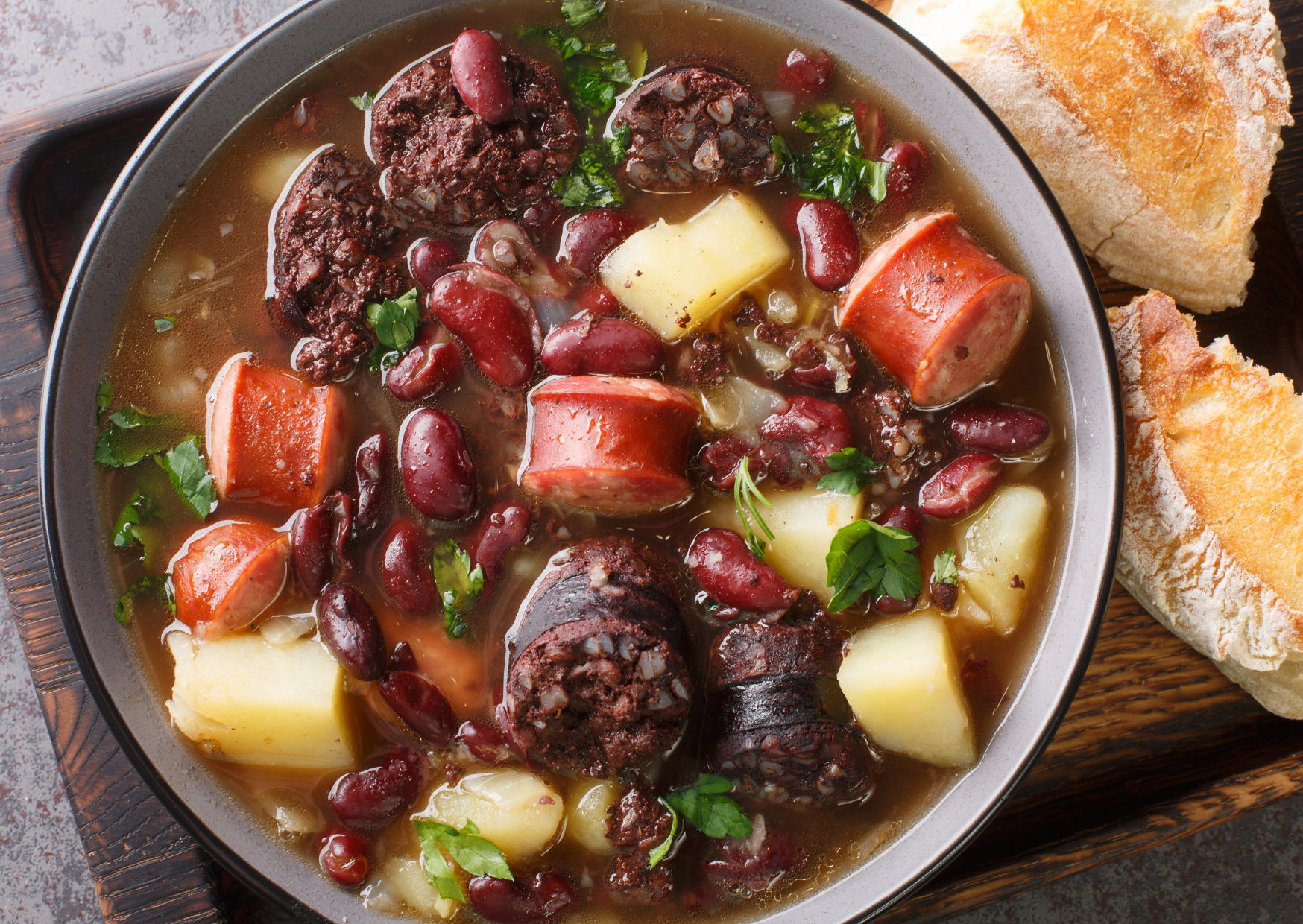
What this dish is and why it shows up on important days
The legend says a hungry friar asked a poor family for a pot of water and a stone, then “accidentally” steered them into adding beans, onions, sausages, and a handful of potatoes. The joke is old. The result is not. Sopa da Pedra is Portugal’s master class in turning scraps into honor. When families gather, the pot gets better cuts, a bright finish of olive oil, and fresh coriander. That is the “special occasion” part. The bones are peasant. The finish is proud.
Remember: you taste generosity, not money, in this soup.
Shopping list with real-world substitutions
You do not need a Portuguese deli to get close. Buy for flavor first, authenticity second.
- Dried beans: 400 g red kidney or butter beans. Portuguese cooks use feijão encarnado or feijão manteiga.
Swap: good quality canned beans work if you are in a hurry. - Smoked sausage: 1 Portuguese chouriço.
Swap: Spanish chorizo, smoked and cured, not the fresh Mexican style. - Blood sausage: 1 morcela. Optional but special.
Swap: black pudding or skip and add more chouriço. - Pork for body: 300 g total from ear, snout, trotter, bacon rind, or pork belly.
Swap: ham hock or smoked pork shoulder bone. You need collagen for body. - Vegetables: 2 onions, 4 garlic cloves, 3 potatoes, 1 small savoy cabbage or a wedge of Portuguese couve, 1 carrot.
- Seasoning: 2 bay leaves, 1 tsp sweet pimentón, black pepper, coarse salt.
- Finish: a good extra virgin olive oil, fresh coriander leaves, red wine vinegar optional.
Key point: at least one smoked piece and one gelatin-rich piece must hit the pot or you lose the famous glossy broth.
Equipment and timing
- One heavy pot or Dutch oven, 5 to 6 quarts
- Ladle, wooden spoon, small skillet for browning
- Time: Soak beans overnight, then 1 hour 45 minutes hands-off for the classic, or 45 minutes if using canned beans and pressure cooker
Bold idea: this is a weekend pot that reheats like a dream. Make it on Saturday, eat it Sunday, love it Monday.
The classic Sopa da Pedra, exactly how Portuguese grandmothers do it
Serves 6 to 8
Active time 30 minutes, total 2 to 2.5 hours
Ingredients

- 400 g dried red or butter beans, soaked overnight and drained
- 1 chouriço, whole
- 1 morcela, whole (optional but recommended)
- 200 g pork belly or bacon rind, in large chunks
- 100 g pork ear or trotter pieces, scrubbed clean
- 2 medium onions, chopped
- 4 garlic cloves, sliced
- 3 potatoes, peeled, cut in 2 cm cubes
- 1 carrot, peeled, sliced
- 1 small savoy cabbage, cored, sliced thick
- 2 bay leaves
- 1 tsp sweet pimentón
- 2 tbsp extra virgin olive oil for the base, more to finish
- Salt and black pepper
- Water to cover, about 2.5 liters
- A “clean” river stone for tradition, scrubbed and boiled 10 minutes (optional and fun)
Method
- Build the base. Warm 2 tbsp olive oil in the pot on medium. Add onions with a pinch of salt and cook until glossy and soft, 8 to 10 minutes. Add garlic, bay, and pimentón for 30 seconds. Soft onions equal sweet broth.
- Layer the meats. Add chouriço, morcela, pork belly, and ear or trotter. Stir once to coat in the onion oil. Do not brown hard. This is a simmered soup, not a stew.
- Add beans and water. Pour in soaked beans. Add water to cover by 3 to 4 cm. Bring to a boil, skim foam, then drop to a gentle simmer. Partially cover. Cook 45 minutes.
- Add roots. Tip in potatoes and carrot. Simmer 25 minutes more until beans and potatoes are just tender. Add cabbage and simmer 15 minutes.
- Season and finish. Remove chouriço and morcela. Slice them thick. Return slices to the pot. Taste. Add salt and pepper. If the broth tastes thin, simmer uncovered 10 minutes to concentrate. Finish with a generous thread of olive oil and chopped coriander. A dash of red wine vinegar is the secret some families use to brighten the pot.
- Serve like a local. Ladle into warm bowls, making sure each person gets beans, veg, and sausage. If you boiled a stone, nestle it in the serving tureen for theater. Put good bread on the table.
What to look for: glossy red broth, soft beans that hold shape, potatoes that do not shatter, greens with a little bite. If it looks muddy, you rushed the simmer. If it looks greasy, you used too much belly. Skim and move on.
Remember: low heat and time turn cheap cuts into silk.
The weeknight 45 minute version that still tastes like Portugal
You are allowed to cheat on a Tuesday. Use canned beans and the pressure cooker.
Serves 4 to 5
- 2 cans red beans, drained and rinsed
- 1 chouriço
- 1 ham hock or 250 g smoked pork shoulder
- 1 onion, 2 garlic cloves, 2 potatoes, 1 carrot, 1 small wedge cabbage
- Bay, pimentón, olive oil, salt, pepper
Pressure cooker steps
- Sauté onion in oil with bay and pimentón.
- Add chouriço whole, ham hock, potatoes, carrot, cabbage, beans. Cover with water by 2 cm.
- Pressure cook 18 minutes on high, natural release 10 minutes.
- Remove meats, slice, return. Season and finish with olive oil and coriander.
Key reminder: the finish makes it Portuguese. Do not skip the coriander and olive oil thread.
Why this broth feels rich without cream
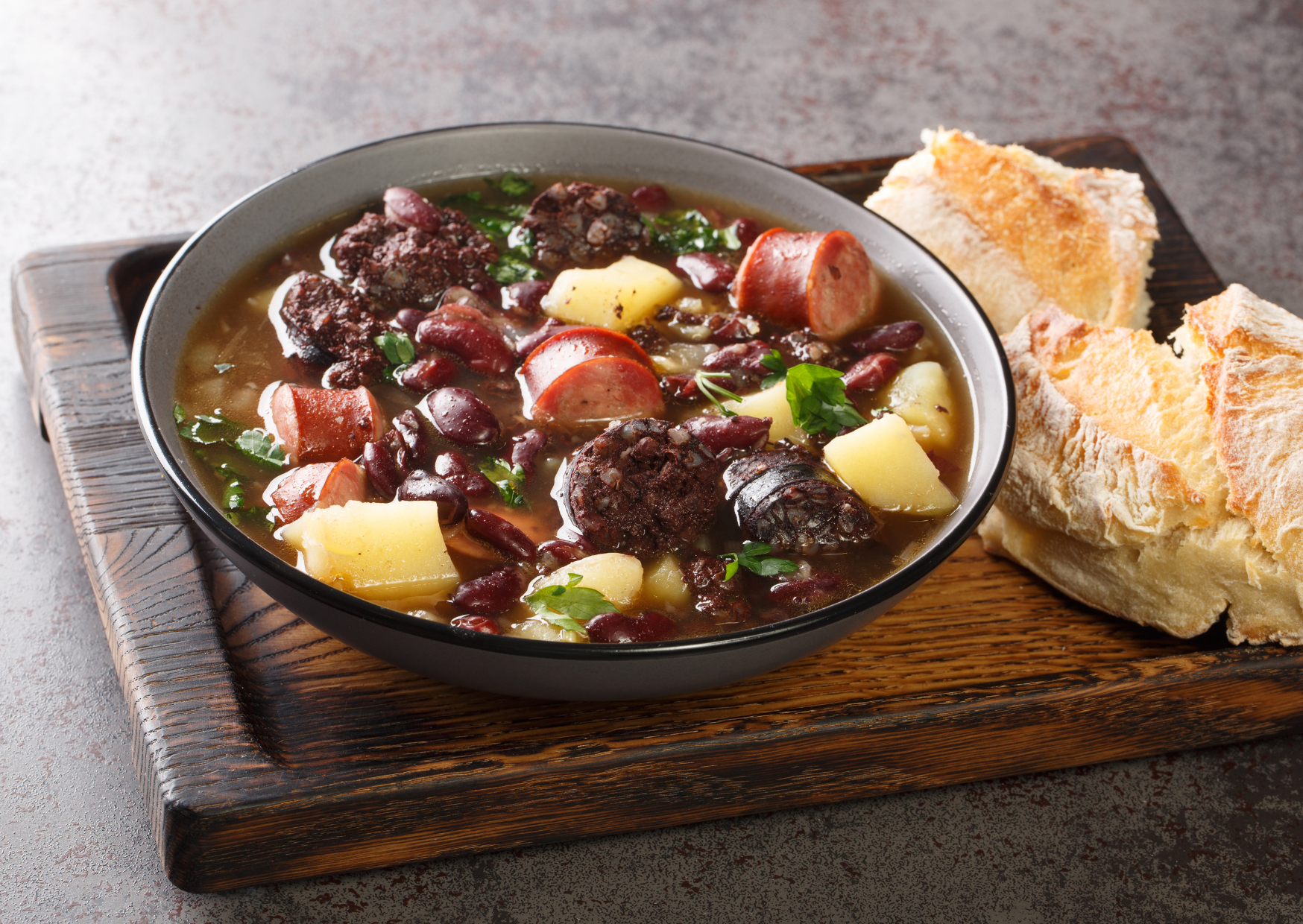
It is collagen and starch doing a slow dance. Pork ear or trotter gives gelatin that glosses the liquid. Beans and potatoes give just enough starch to suspend flavor. The olive oil at the end carries aroma. You engineered body without dairy. That is why the soup eats like a meal.
Bold thought: body is a technique, not a calorie bomb.
Costs that make this a holiday keeper
Prices shift by town, but the math holds across Iberia and most U.S. cities with access to smoked sausage.
- Beans €1.20 to €1.80 or $1.50 to $2.50
- Chouriço €3.50 to €5.50 or $5 to $8
- Morcela €3 to €4.50 or $4 to $7
- Pork cuts €3 to €6 or $4 to $8
- Vegetables and pantry €4 to €6 or $5 to $8
Total for 6 to 8 bowls sits in the €15 to €22 or $20 to $30 band. That is three euros a person for a main course with leftovers that improve.
Remember: Portuguese food buys flavor with time, not with price.
Make it American-grocery-proof
- No chouriço: buy Spanish-style smoked chorizo or kielbasa plus 1 tsp smoked paprika.
- No morcela: skip or add a few slices of cooked Italian sausage for extra meatiness.
- No ear or trotter: add a ham hock. You will still get gelatin.
- No savoy cabbage: use curly kale or collards, chopped and added five minutes earlier.
Bottom line: you need smoke, you need gelatin, you need greens. The rest is flexible.
Lighter holiday version that still reads as festa
Special days in Lisbon often swap ear for leaner pork and add clams. It becomes Sopa da Pedra with manners.
- Keep chouriço.
- Use lean pork shoulder instead of belly.
- Finish with a handful of amêijoas or littleneck clams. Simmer 4 minutes until they open.
- Brighten with lemon and coriander.
Result: same soul, cleaner finish. Good when your table includes cousins who count things.
Serving rules that make it feel Portuguese, not themed
- Bread on the table. Country loaf, slightly stale is perfect.
- Olive oil on the side so guests can thread a little more richness.
- Coriander on the table. Half your guests will add more.
- Vinho tinto from the region if you have it, or any honest red.
- Small bowls first, then seconds. Let people build their own portion.
Key cue: you are feeding conversation as much as stomachs.
Leftovers strategy so day two tastes like day one
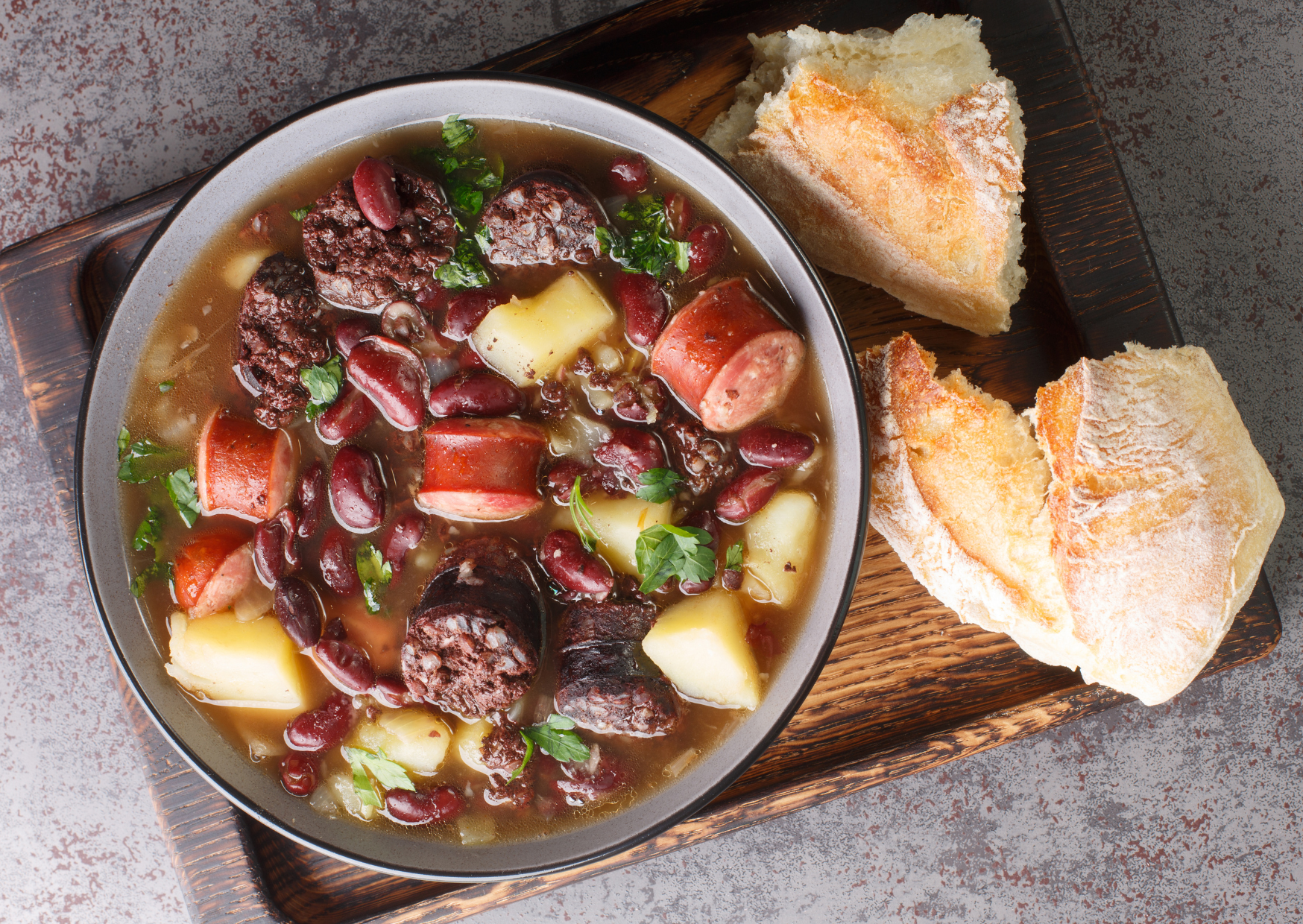
- Cool the pot fast. Remove sausages so they do not over-steep the broth. Chill separately.
- Reheat gently. Add a splash of water if the broth tightened.
- Freshen with coriander and a thumb of olive oil.
- Next-day trick: poach an egg directly in the simmering soup for 4 minutes. Rich on rich, still simple.
Remember: this soup holds three days easily and freezes well without the potatoes.
Mistakes Americans make and the fix
- Boiling hard which bursts beans and clouds the pot. Simmer gently.
- Under salting until the end, which makes bland meat. Salt lightly when you add water, adjust later.
- Skipping the finish because the soup already looks good. Olive oil and coriander are the signature.
- Using fresh Mexican chorizo which breaks and greases the pot. You need smoked, firm sausage.
Short rule: low heat, right sausage, real finish.
The five minute story you can tell at the table
A friar knocks, a family has nothing, a pot of water meets a harmless rock, then one onion, then a carrot, then a sausage if they have it, then a few beans. Everyone laughs, everyone eats, and the house learns that sharing is what turns poverty into dinner. That is why grandmothers still make it for celebrations. It reminds people what turns a house into a family.
Bold reminder: humble food becomes special when you feed it to people you love.
Full printable recipe card
Sopa da Pedra, Portuguese “Stone Soup”
Serves 6 to 8
Ingredients
400 g dried red or butter beans, soaked and drained
1 chouriço, whole
1 morcela, whole optional
200 g pork belly or rind, in chunks
100 g pork ear or trotter, cleaned
2 onions, chopped
4 garlic cloves, sliced
3 potatoes, peeled, 2 cm cubes
1 carrot, sliced
1 small savoy cabbage, thick slices
2 bay leaves
1 tsp sweet pimentón
2 tbsp olive oil, more to finish
Salt, black pepper
2.5 liters water
Coriander to finish, red wine vinegar optional
Method
- Sweat onions in olive oil with bay and pimentón, 8 to 10 minutes.
- Add chouriço, morcela, pork belly, ear or trotter. Stir.
- Add beans and water. Boil, skim, then simmer 45 minutes.
- Add potatoes and carrot. Simmer 25 minutes. Add cabbage. Simmer 15 minutes.
- Remove sausages, slice, return. Season. Reduce uncovered 10 minutes if needed.
- Finish with olive oil and coriander. Vinegar optional. Serve with bread.
What to remember: smoke for depth, collagen for body, olive oil for shine. That is the whole secret.
If you make it once this winter, you will understand why it sits on holiday tables without apology. It is not fancy. It is complete.

About the Author: Ruben, co-founder of Gamintraveler.com since 2014, is a seasoned traveler from Spain who has explored over 100 countries since 2009. Known for his extensive travel adventures across South America, Europe, the US, Australia, New Zealand, Asia, and Africa, Ruben combines his passion for adventurous yet sustainable living with his love for cycling, highlighted by his remarkable 5-month bicycle journey from Spain to Norway. He currently resides in Spain, where he continues sharing his travel experiences with his partner, Rachel, and their son, Han.