
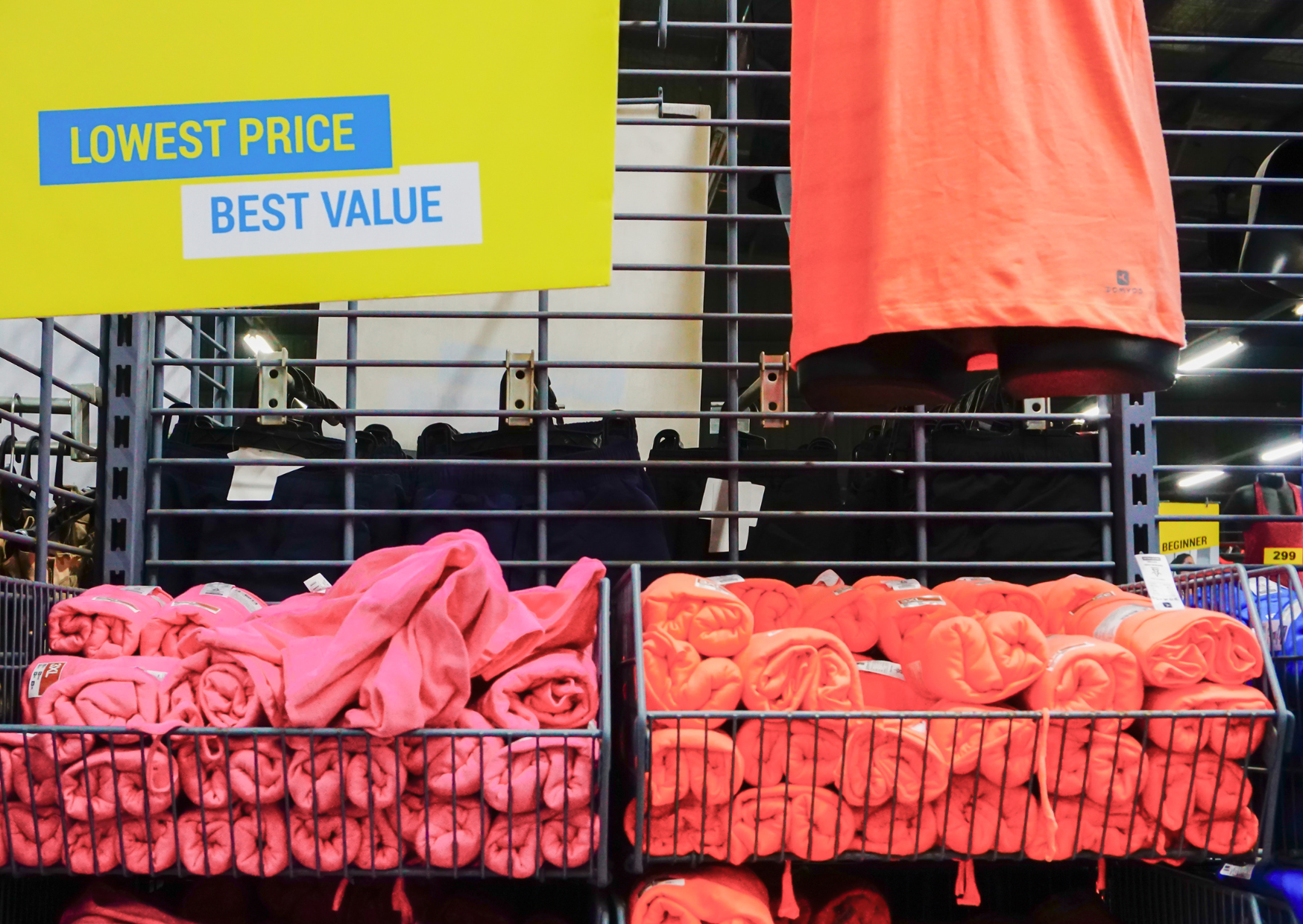
On a Saturday morning in a coastal town, a family walks into a blue-and-white warehouse and leaves twenty minutes later with everything needed for a hike and a swim. A €29.99 backpack, €11 swim shirts, a €6 water bottle, a pair of €12 sandals, and a mask-and-snorkel set that does not scare the Visa bill. No performance theater. No velvet hangers. Just gear that works and a receipt that reads like groceries.
What Decathlon Actually Sells
Decathlon is not a boutique. It is a sports infrastructure store. The aisles are filled with what people use every week, priced so that a new sport is a small decision rather than a luxury. The secret is structural. Decathlon designs, manufactures, and sells its own “passion brands” under one roof, controlling the supply chain from sketch to checkout. Vertical integration keeps prices low while quality stays respectable, and the result is a store that can outfit a household without turning the purchase into a status project.
Those “passion brands” are not random logos. Quechua covers hiking and camping, Domyos handles fitness, Van Rysel targets road cycling, Kipsta supplies team sports, Nabaiji and Subea run the pools and snorkeling, and Tribord lives on the coast. The company runs more than twenty in-house lines and has rebranded in the past two years to make the portfolio simpler to read in-store. One building, many sports, one price philosophy is the idea.
The €30 Basket That Keeps Winning
You can feel the strategy in a single basket. A typical Decathlon trolley for a beginner’s weekend might include a Quechua 30 L hiking backpack for €25 to €30, UPF 50 swim shirts under €15, a basic water bottle for under €10, and a starter snorkel set around €15 to €45 depending on country and model. The point is not one SKU. The point is the price band. A family can walk out with four complete kits for less than the cost of one premium outfit in a U.S. mall.
To make the contrast human, put like with like. A Decathlon Quechua MH100 35 L backpack lists around $30 on the U.S. site and £17.99 to £29.99 for similar 30 L packs in the UK. A popular U.S. alternative is not crazy expensive, but it often climbs fast once branding enters the chat. Decathlon’s basket makes trying a sport cheap. There is no need to wait for a birthday, a sale, or a tax refund.
Why Americans Pay More For The Same Day
Two forces make American receipts heavy. Brand theater and fragmented shopping.
Brand theater is the mall layer. A pair of training shorts at a prestige brand regularly retails at $68 to $98 unless a rare sale is running. The Lululemon Pace Breaker short sits in that band, with periodic markdowns that still leave a single pair at $39 to $69. Patagonia Baggies are a cult item at about $69 in most shops. These are good products, but the default price of entry for a basic item is not basic at all. You pay for the name long before you test the seam.
Fragmented shopping is the second force. A U.S. family might visit three retailers to gear up: a fashion-driven athleisure brand for clothing, a big-box for accessories, and a specialty shop for equipment. Each layer adds margin, shipping, and time. Decathlon collapses the trip. One cart, one receipt, three sports covered is not marketing. It is architecture, and architecture lowers cost.
How Decathlon’s Model Beats Everyone On Price
The playbook is simple and repeatable.
Private label at scale. Decathlon designs almost everything it sells and markets it under house brands like Quechua, Tribord, Domyos, Nabaiji, Van Rysel, and Kipsta. Owning design and distribution compresses costs and lets the company price a backpack at €25 while a rival sells the same capacity and fabric for three times as much in a different box.
Breadth under one roof. The stores carry seventy-plus sports. A swimmer buys a cap, then notices a €30 day pack and a €12 yoga mat. Cross-sport impulse is engineered for utility, not aesthetics, and the price points keep the impulse healthy instead of indulgent.
Circular services. Repairs, buyback, and second-life racks extend product life and lower the entry price again. Germany has expanded textile repairs through partnerships so a torn jacket returns to use instead of going to landfill. In the UK, the buyback service refurbishes thousands of bikes a year. The circular share of revenue is still modest, but it is growing, and circularity is a price cut disguised as sustainability.
Customer-friendly returns. Returns windows vary by country, but the European sites are explicit about generous timelines for members, with 365-day returns in some markets and 30 days elsewhere. Shoppers read that and try a new sport because the downside is small. Confidence lowers friction, and lower friction sells gear.
A Like-for-Like Basket: One Saturday, Two Receipts
Consider a simple day: hike in the morning, swim in the afternoon. Outfit one adult and one preteen with basic, decent gear. No luxury, no austerity.
European basket at Decathlon
- Quechua daypack around €25 to €30.
- Two UPF shirts around €8 to €15 each.
- Simple water bottle around €6 to €10.
- Subea mask-and-snorkel kit around €15 to €45 depending on model and country.
- Lightweight towel around €7 to €12.
Total: often €70 to €110 for two people, less during promotions and in countries with lower VAT on sporting goods.
Typical American basket at prestige and specialty stores
- Branded daypack equivalent: $60 to $120 for an entry model.
- Two branded performance shorts at $68 to $78 each unless a sale is on.
- Hydro Flask 32 oz water bottle $44.95 list.
- Snorkel set from a general sports retailer $30 to $70 for a beginner kit.
Total: commonly $240 to $390 before tax. If you shop a sale, you may save fifty dollars. The anchor prices do not change. Two stores, one mall, big receipt.
The gap is not about quality so much as appropriate spec. Decathlon sells “good enough” for ordinary use and “very good” for enthusiasts under different sub-brands, inside the same building. The mall sells “aspirational” first and “good enough” only on clearance.
What Americans Miss About “Cheap” Gear
Cheap is a feeling. Value is a design choice. Decathlon’s engineers design for a target use case and put money where it matters: fabric hand, seam placement, zips, and coatings that do not fail in week three. When you handle a Quechua pack or a Nabaiji suit, the quality is not couture. It is honest durability at a price that invites use.
This matters for beginners. When the first cost to try a sport is small, more people try. If the sport sticks, Decathlon sells the next tier in the same aisle. If it does not, the second-life rack takes the gear back and gives it another go with someone else. That is not romance. That is throughput.
Europe’s “Do The Thing” Culture And Why Decathlon Fits It
Public parks, urban trails, municipal pools, and bike lanes form a map that rewards participation. A running shirt is used four mornings a week because the path is outside the door. A €30 backpack gets muddy because there are ten short trails reachable by tram. When the environment invites movement, gear becomes a tool instead of a costume.
Decathlon’s stores mirror that map. You can walk in for a swim cap and find a lane of snorkel sets priced so that a family can play without anxiety. You can fix a puncture at a workshop counter and then ride away. You can put together a camping setup that is not Instagram-perfect and still sleep well. The price makes the decision easy, and easy decisions are the ones households repeat.
But Is It Any Good After Six Months
The honest answer is that most Decathlon products are better than their price suggests, and a few are only fine. That is the bargain. You trade stitched logos for iterative design based on thousands of returns and comments flowing into a central system. A popular pack with 7,000 ratings at four and a half stars tells you something a hangtag never will. You also trade boutique lifetime warranties for repairs and replacements that are quick and local, not ceremonial. Europe’s repair expansion in Germany is a good signal for where the company is going. Fix the product, not the brand narrative.
When Premium Still Wins
There are domains where a premium brand is the right call. If you run ultramarathons, you will want a very specific short with a liner that never argues. If you live in the water and surf daily, a high-end suit earns its keep. If you ride all day, the Van Rysel race bike will pull you into a conversation with carbon and fit that goes well beyond €30. Serious use cases justify serious budgets.
What Decathlon changes is not the top of the market. It changes the baseline. A beginner can learn without debt. A family can play every weekend. A casual runner can kit out for less than the price of one prestige hoodie. The presence of a €30 option does not insult the €150 product. It forces the €150 product to prove itself.
The Psychology Of Receipt Shock
A U.S. mall receipt feels heavy because branding, fittings, and fixtures eat margin before fabric does. You pay for a curated experience and an identity story, which is fine if that is what you want. European families walking into Decathlon pay for square meters and throughput. The store reads like a warehouse because the money goes to what leaves the building, not to what decorates it. The human result is simple. You buy the thing and go do the thing.
This is why, culturally, Decathlon dominates Saturday mornings in half the towns on the continent. It is not a personality. It is a service.
A Quick Reality Check On U.S. Alternatives
Americans can still use the playbook at home.
Decathlon sells online in the United States with many core SKUs at European-like prices. Quechua backpacks around $22 to $30 appear regularly, and basic swim and fitness lines show up with the same house-brand logic. If you prefer to shop domestically at a co-op or big-box, you can mimic the basket by choosing private-label lines and resisting the siren call of new-season colors. The math is the same. Buy for the use case, not the logo, and your household will spend less while doing more.
The Four Rules That Keep The Cart Honest
Use bullets rarely, keep them short, and make them useful.
- Set a per-item ceiling. If an entry piece costs more than €30, there should be a real reason.
- Buy the boring color. It integrates with next year’s kit and avoids trend tax.
- Shop the house brand first. If a premium piece adds a function you can describe, buy it. If not, stay in the aisle.
- Spend where the body complains. Shoes, chamois, and long-wear layers deserve the upgrade. Bottles, daypacks, and towels do not.
Follow these and the receipt starts looking like a train ticket instead of a luxury purchase.
What This Means For A Family Budget
Decathlon’s existence changes more than a gym bag. It changes weekends. A €100 to €150 family budget buys a month of activity when the individual pieces sit at €6, €12, €30 instead of $68, $98, $149. The result is not minimalism. It is participation at scale.
Households that adopt the structure report the same pattern. Saturdays become hikes or rides because the kit is already paid for and already in the hall. Weeknights include swims because caps, goggles, and suits were cheap and comfortable, not aspirational and precious. Children try two sports in the same term because the cost of failure is low. The best part is the most boring. A €30 purchase is easy to forget if the sport is not for you, and easy to pass on or resell if it is.
The One-Shelf Test
Stand in front of a single Decathlon shelf and ask three questions.
- Can I outfit the next three weekends here without visiting another store.
- If I bought the cheapest option, would the day still work.
- Where would spending more improve comfort, safety, or durability that I can feel in month three.
If you get three yes answers and one clear upgrade case, you are in the right building. Most shoppers do.

About the Author: Ruben, co-founder of Gamintraveler.com since 2014, is a seasoned traveler from Spain who has explored over 100 countries since 2009. Known for his extensive travel adventures across South America, Europe, the US, Australia, New Zealand, Asia, and Africa, Ruben combines his passion for adventurous yet sustainable living with his love for cycling, highlighted by his remarkable 5-month bicycle journey from Spain to Norway. He currently resides in Spain, where he continues sharing his travel experiences with his partner, Rachel, and their son, Han.