
Madrid in January. The radiators hiss to life, warm the hallway, the spare room, and the kitchen you barely use at night. The bill arrives and your eyebrows lift. Meanwhile your neighbor is reading on the sofa in a pool of quiet heat with a tiny ceramic unit at her feet, windows aired, doors shut, and a smart plug ticking away. The rest of the flat sits cool. Her bill lands and she shrugs. The secret is not a miracle device. It is a Spanish way of running heat that focuses warmth where you are, for the exact minutes you need it.
This is the working playbook for flats across Spain that run on mixed systems, old radiators, or electric tariffs that punish whole-apartment heating. You will see how people set up the space heater correctly, where they place it, what the timer does, why window airing and door discipline matter, and a simple cost sketch that shows why this beats central heat on weeknights. No gimmicks. Just zoned comfort with low effort and lower cost.
What Spaniards Actually Do When It Gets Cold At Home

There is a pattern in Valencia, Madrid, Zaragoza, Sevilla. People do not heat the whole apartment all evening. They heat the room they are in and keep the rest at a background low.
They run central heat shorter, not never.
You will still see radiators for a quick evening prewarm, then off. The comfort work is finished by a small ceramic or oil-filled radiator placed near the human, not the wall. Heat where you sit beats heating the air behind a door.
They pick the right heater for the job.
Living rooms get a 1,500 to 2,000 W ceramic tower with a real thermostat and tip switch. Bedrooms see a quiet oil-filled radiator at 800 to 1,000 W that glows slowly and keeps the room even. Match the room, not the brand.
They control time, not temperature slogans.
Smart plug timers or the heater’s built-in timer run 20 to 40 minute bursts, then rest. Doors stay closed. Windows are aired wide for 3 to 5 minutes before the evening, not tilted for an hour. Short airing plus closed doors gives you dry air that warms fast for pennies.
Why it wins: central heat tries to make all rooms equal. A space heater makes your square meters perfect and leaves the rest of the house peacefully cool. Targeted heat is cheaper heat.
The 5-Minute Setup That Changes Your Evenings
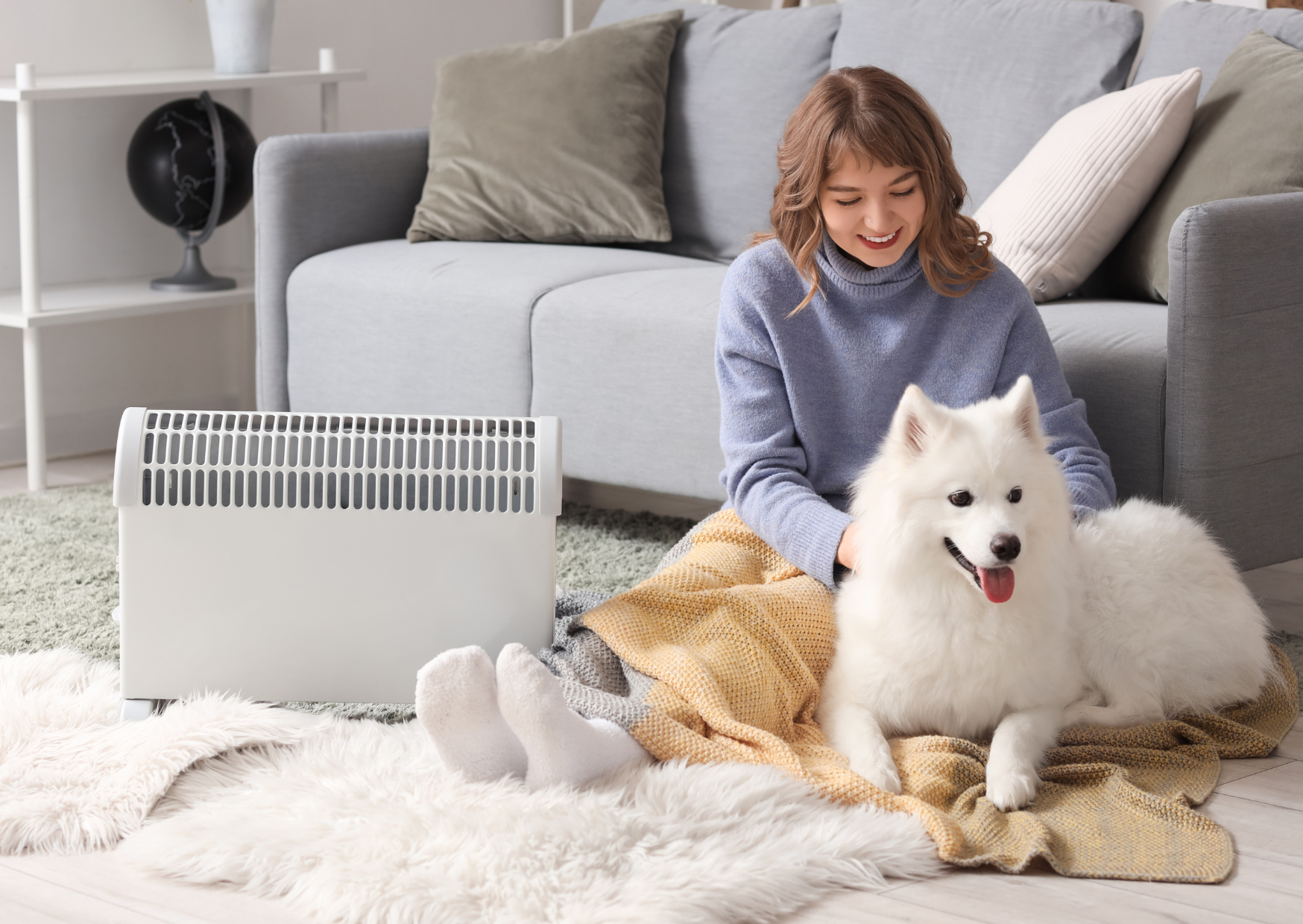
You do not need a shopping spree. You need a safe unit, good placement, and door discipline.
Choose the right unit for the room
For a sofa corner or desk, pick a ceramic tower with thermostat and tip-over cutout. Look for overheat protection and a stable base. For a bedroom, pick an oil-filled radiator with adjustable wattage and thermostat. Fast flow for living spaces, slow soak for sleep.
Place it where physics helps you
Put the ceramic unit 1.5 to 2 meters from your seat, pointed at your body space, not the center of the room. Keep 1 meter clear in front of it and 50 cm to the sides. Do not block curtains. Direct line of warmth feels better at lower room temperature.
Pair with a smart plug and a door
Plug into a smart plug with an auto off routine. Close the door to the room. The door is a heater. It keeps warmth inside where you feel it. Doors make kilowatts act bigger.
Air first, then heat
Open the window fully for 3 to 5 minutes before you sit down. Shut it. Dry air warms with less energy and reduces the “damp chill” that makes you crank the dial. Dry beats high.
Set the thermostat once
Find the lowest dial setting that feels comfortable after 10 minutes, then leave it. Constant low beats constant fiddling.
Safety basics that locals follow
Use a grounded outlet, never a power strip for high wattage. Keep heaters off rugs and away from fabrics. If you leave the room for long or sleep with a ceramic blower, turn it off. Oil-filled units can stay on low in bedrooms when supervised and placed clear. Safety first, warmth second.
The result: a warm cone of comfort around your evening life, with the rest of the home barely sipping energy.
Why This Works Physically Even In Leaky Flats
No politics here. Air, humidity, and bodies set the bill.
You heat bodies and surfaces, not empty rooms
A ceramic unit throws radiant and convective heat right at you. Your skin, clothes, and sofa warm quickly, so you feel good at 19 to 20 °C room air instead of chasing 21 to 22 °C throughout the house. Comfort at lower air temp is the entire savings story.
Dry air cuts the energy needed
Spain’s winter air can be dry outdoors but wet indoors from showers and cooking. A short, wide airing dumps indoor moisture so the heater is not fighting water in the air. Moist air needs more energy to feel warm. Dry once, save all evening.
Closed doors shrink the space you must heat
A door takes your 50 m² flat and makes it a 12 m² bubble. Every watt has more effect. Small air volume, faster comfort.
Oil-filled radiators flatten peaks
They warm oil mass, not coils. They cycle slowly and keep bedrooms steady without hot then cold waves. If you air the room and set the wheel at low, your sleep stays even and your meter stays polite.
Central heat is great for mornings, not marathons
Run central for 30 to 60 minutes while you get home or wake up. Then hand the baton to the space heater in the room you stay in. The system does the bulk lift, the small unit handles precision comfort. Teamwork beats brute force.
The Cost Picture On One Simple Evening
Numbers make the choice obvious. Here is the weeknight that most people actually live.
Scenario A: central heat on from 18:30 to 23:30
Older gas or whole-apartment electric systems often draw 3 to 6 kW equivalent to keep an entire flat at 21 °C when nights drop. Even with modern boilers the duty cycle over four to five hours is real. At €0.18 to €0.25 per kWh on current tariffs, that is €2.16 to €7.50 for the evening, depending on shell and system, plus keeping rooms warm that no one is using.
Scenario B: 45-minute central prewarm, then a 2 kW ceramic for the sofa
- Central from 18:30 to 19:15 to take the edge off.
- Door closed. Window aired and shut.
- Ceramic heater on 2 kW for 15 minutes, then cycling at 1 to 1.2 kW as the thermostat modulates, total runtime 90 to 120 minutes across the evening.
- Total draw for the night sits around 1.8 to 2.5 kWh for the heater plus 0.7 to 1.2 kWh for the prewarm.
- At €0.18 to €0.25 per kWh, you pay roughly €0.45 to €0.63 for the heater and €0.13 to €0.30 for prewarm on the low end of shells, up to €0.63 + €0.50 on drafty nights. Call the band €0.60 to €1.30 for comfort all evening in the lived room.
The point: you moved from heating every room for hours to heating the room with humans for minutes. That is where the money disappears from the bill.
The Two Heaters That Actually Make Sense

You do not need ten options. You need one quiet ceramic and one oil-filled.
Ceramic tower for living spaces
- Power: 1,500 to 2,000 W
- Must have: tip switch, overheat cutout, real thermostat, stable base
- Nice to have: oscillation, eco mode, washable filter
- Use: sofa nights, home office sessions, kitchen table after dinner
- Why: fast warm at body level, then cycles low
Oil-filled radiator for bedrooms
- Power: 800 to 1,000 W on low, 1,500 W on high
- Must have: thermostat, adjustable wattage, wheels
- Nice to have: 24 h timer, anti-frost setting
- Use: preheat room before bed, maintain a cool 17 to 18 °C steady
- Why: even heat, almost silent, safe overnight on low when placed correctly and supervised
Avoid fan-only bathroom blasters for evening rooms. They are fine for 5 minutes in a bathroom with a person in the room but noisy and uneven for a lounge. Match tool to task and you win.
Where To Put It So You Feel Warm At Lower Settings

Placement is half of comfort.
Aim at the person, not the room
Angle the stream toward your legs and torso, not toward a wall. You want direct radiant feel so you do not raise the entire air volume more than needed. Personal warmth equals lower bills.
Keep a clear lane
No curtains in front, no textiles near the grille, no shelves above that trap heat. A clear cone makes the thermostat honest.
Use the door like a lid
Close the door. If the door leaks, roll a draft stopper against the bottom. Your heater becomes twice the size when the room is sealed.
Respect distances
Front clearance 1 meter, sides 50 cm, rear 30 cm. Carpets are fine if low pile and away from the grille. Never tuck under a tablecloth. Safety is comfort insurance.
The Evening Routine That Locals Swear By
Steal this sequence and you will stop touching the dial.
18:15 Air the living room wide open for 3 to 5 minutes, door closed, radiator valves off or low. Shut the window.
18:30 Central system on. Go about your evening jobs.
19:10 Central off. Door to living room closed. Smart plug turns ceramic heater on for a 15 minute burst.
19:25 Heater drops to thermostat hold. You feel toasty at the sofa with room air at 19 to 20 °C.
20:30 Timer off. If you still feel dull chill, run another 15. Many nights you will not need it.
22:30 Bedroom aired wide for 3 minutes. Oil-filled radiator at low, door closed. Brush teeth, come back to a settled room. Turn off before sleep if you prefer, or leave at low if supervised and safely placed.
Result: you used central for one hour, a ceramic for one to two hours, and an oil unit for thirty minutes. Comfort all evening, money left for morning coffee.
Common Mistakes That Make Space Heaters Seem Expensive
These are the traps. They are easy to avoid.
Running the ceramic with the door open
Warm air escapes to the hallway, the thermostat never satisfies, the unit runs nonstop. Fix: door closed always.
Tilting windows for an hour
You cool walls and furniture while the heater runs. Fix: wide open 3 to 5 minutes, then full shut.
Aiming at empty space
People try to heat the whole room air first. Fix: aim at your body for ten minutes, then let the thermostat cycle.
Using a power strip
High draw on a strip is a bad idea. Fix: plug directly into a wall outlet with proper grounding.
Sleeping with a blower on high
Noisy and dry. Fix: use oil-filled low before bed and turn off when comfortable, or preheat then rely on duvet.
Parking the heater under a desk with fabrics
Fire risk and hot legs. Fix: keep clearance, always.
Apartment Archetypes In Spain And How To Tweak The Plan
Every building has a personality. Adjust one notch.
Eixample or Chamberí high ceilings
Big volume, gorgeous windows. Use two short ceramic bursts and a door snake. Consider a small oil-filled unit in the corner to smooth drafts.
1970s brick with central gas
Good bones, mixed insulation. Central 30 to 45 minutes, then ceramic. Bedrooms run oil low for preheat, then off.
New build with tight windows and splits
If your split heat pump is efficient, use split on eco to prewarm at low cost, then ceramic for body heat when you sit. Air exactly, not long.
Sea humidity zones
Airing is your best friend. Dry the room, then run lower wattage longer. Moist air is the enemy of comfort and bills.
A Quick Budget Snapshot For One Cold Month
Assume 30 evenings at home. Compare typical patterns.
Whole-apartment habit
- Central heat 4 h per night at mixed duty equivalent of 3 kWh per hour average draw across rooms
- Monthly energy: 360 kWh
- At €0.18 to €0.25, total €64.80 to €90.00
Spanish space heater habit
- Central prewarm 1 h at 3 kWh average draw
- Ceramic total runtime 45 to 120 min at 1 to 1.5 kWh average draw due to cycling
- Oil-filled 30 min at 0.8 kW
- Monthly energy: roughly 90 to 150 kWh depending on shell and self-control
- At €0.18 to €0.25, total €16.20 to €37.50
Savings band: €27 to €74 for a single person who sits in one main room each night. Families who still gather in one room see similar percentage wins. If you also stop heating unused rooms for hours, the spread grows. You do not need miracles, you need a door and a timer.
Little Upgrades Under €30 That Pay Back In A Week
You can do this with what you have, but these are the small wins.
- Smart plug with timer so the unit never runs longer than it should
- Draft stopper for the living room door
- Analog hygrometer on a shelf so you air by numbers, not guesses
- Thermal curtains that stop window chill while leaving the heater’s path clear
- Power meter plug for one evening to see the real draw and kill myths
Each nudge turns good habits into default behavior.
What To Tell Your Housemates So Everyone Plays Along
“We heat the room we are in.” Put the heater in the group room and agree a door rule.
“Air wide for five, then shut.” Tape a note for the first week. Short airing, not tilt.
“Timer on, then off.” The smart plug is the boss. If you are cold after twenty, blanket plus five minutes, not indefinite on.
“Bedroom is steady, not hot.” Oil low for ten minutes, then duvet. Better sleep, better bill.
What This Means For You
You do not need to choose between shivering and a high invoice. The Spanish hack is simple. Prewarm smart, close the door, air briefly, and heat the human, not the whole home. A ceramic tower for living space and an oil-filled radiator for the bedroom, both run on short timers with a thermostat, beat central heat on the nights you actually live. Pair that with five minutes of window wide open and you will feel warmer at lower numbers and watch your bill slide down without feeling heroic.
If you only change one thing, change where the heat points. Aim the warmth at your life. The rest of the rooms can nap until morning.

About the Author: Ruben, co-founder of Gamintraveler.com since 2014, is a seasoned traveler from Spain who has explored over 100 countries since 2009. Known for his extensive travel adventures across South America, Europe, the US, Australia, New Zealand, Asia, and Africa, Ruben combines his passion for adventurous yet sustainable living with his love for cycling, highlighted by his remarkable 5-month bicycle journey from Spain to Norway. He currently resides in Spain, where he continues sharing his travel experiences with his partner, Rachel, and their son, Han.