
You step onto a Tube escalator, park yourself on the left with a carry-on, and feel a rush of elbows and sighs gathering behind you.
If you grew up where escalators are social space, London feels brutal. You thought everyone stands wherever there is room. Londoners see an organised conveyor belt. The right side is for standing. The left is a passing lane. Your bag, your body, and your good intentions are now blocking the commute. A tut becomes a nudge. A nudge becomes a shoulder. You are not being singled out because you are American. You are interrupting a script everyone around you learned at twelve.
This is not a personality quiz. It is a flow rule that keeps deep, crowded stations from stalling. Once you understand the history, the math, and the etiquette, the city stops shoving you and starts carrying you.
Want More Deep Dives into Other Cultures?
– 9 Italian Style Rules That Instantly Outshine American Fashion
– Why Europeans Walk Everywhere (And Americans Should Too)
– How Europeans Actually Afford Living in Cities Without Six-Figure Salaries
– 9 ‘Luxury’ Items in America That Europeans Consider Basic Necessities
What “Stand Right, Walk Left” Actually Means Here

On London Underground escalators, the default is simple. Stand on the right. Walk on the left. If you are not walking, you and your luggage live on the right-hand side, single file. That convention is so common that you will see it printed on escalator balustrades and in posters in older stations. It is not quaint. It is how a million people get to work without turning into a scrum at the top.
There is a safety rule behind the manners. The UK’s railway byelaws say you must use escalators only by standing or walking in the intended direction, and that you must obey safety notices. On the Tube, one of those notices is literally Stand on the right. That makes the etiquette a posted instruction, not only a vibe. When staff tell you to move right, they are not being fussy. They are enforcing the sign and the flow.
If you need a United States comparison, think of Washington Metro. The stand-right habit is strong there too, but it is a norm, not a capital-wide religion. In London, it is both norm and instruction, and people act like it. You are free to walk on the left if the way is clear. You are not free to make the left lane a luggage shelf.
Scan this, then step: right to stand, left to pass, bags on your step, not in the lane.
Where The Rule Came From, And Why London Cares So Much

Escalator etiquette in London is old. Early Underground escalators pushed riders to disembark to one side, which encouraged a split between standers and walkers. By the 1920s, stations were literally broadcasting recorded announcements telling riders to keep moving and, if you must stand, stand on the right. The message stuck. A century later, the phrasing still rings in station posters and announcements.
The physical network makes the habit necessary. London’s central stations have very long, very busy escalators. At Holborn, for example, escalators are so deep that most people will not walk them, which means the only way to prevent empty steps is to fill both columns of standing passengers. Transport for London even ran trials at Holborn to test whether suspending the left-hand walking lane on some escalators would move more people. The math said yes. The culture said no. We will come back to that.
The point is that London escalators are not background furniture. They are pressure valves. When you leave the left lane open, walkers climb past and the top platform clears faster. When you block the lane, the merge at the landing jams, tempers rise, and staff end up on the loudhailer. There is a reason the slogan endured. It keeps the machine from stalling.
Street translation: the rule has a history, the network has depth, and Londoners have muscle memory for keeping it moving.
The Flow Math That Outsiders Miss

If you only remember one number, remember this. In the Holborn trial, an escalator where everyone stood two-abreast moved around 151 people per minute, while the one where some stood and others walked moved about 115 per minute. When it is busy, standing on both sides is more efficient on long escalators, because the left lane used by walkers leaves gaps. So why does London still keep a walking lane at most places most of the time? Because behavior and capacity are not the same problem.
TfL’s own trial notes spelled it out. Asking people to stand on both sides improves flow on long escalators at peaks, but it collides with a century of practice, causes frustration, and needs constant staff presence to work. When the trial ended, London reverted to the habit that people will obey without being told. The city chose predictable courtesy over theoretical throughput, then kept the standing-both-sides trick in reserve for specific bottlenecks. That is the Tube in a sentence. Use hard rules when needed. Use habits the rest of the time.
There is another practical reason the walking lane survives. On shorter escalators where lots of people do walk, a left passing lane clears clumps quickly and reduces the gnarl at the egress. Your job, as the visitor, is not to argue the engineering at 8 a.m. Your job is to notice which kind of escalator you are on, read the lane, and follow the local rhythm.
Bottom line for brains and bodies: long and packed favors two-abreast, culture still expects a passing lane, you are not here to reinvent commute physics.
Safety, Byelaws, And Why Staff Bark About Bags

London treats escalators as safety equipment. The railway byelaws make three things clear. You use escalators only by standing or walking in the intended direction. You do not interfere with the equipment. You obey reasonable safety notices and instructions. None of that mentions a left passing lane, but it gives staff the authority to tell you to follow the posted Stand on the right sign and to move luggage that is creating an obstruction. If you argue, you are arguing with the rulebook, not the person.
The safety context is not abstract. TfL records thousands of slip, trip, and fall incidents on escalators across the network in a typical multi-year window, with the biggest stations topping the lists for total incidents simply because of volume. When the system is near capacity, one blocked lane, one rolling suitcase, one sharp stop can cascade into a pileup. That is why you will hear staff say keep the left clear, hold the handrail, and mind long coats and scarves. The campaign is not manners theatre. It is injury prevention.
Short version, if a member of staff asks you to shift, treat it like a seatbelt sign. The Tube is fast because people do what the signs say without a debate.
Safety takeaway: byelaws back the signs, incidents are real, staff instructions are not optional.
The Practical Playbook So You Stop Getting Shoved
You do not need to become British. You need a checklist.
Enter right. Before you step on, look down at the steps and at the people ahead of you. If they are standing, join the right column smoothly. If you intend to walk, move quickly to the left column and keep a steady pace. Do not drift between lanes.
Manage your luggage. Keep your bag on the step in front of you or directly by your calves, not angled into the left lane. If you have two bags, stack them front-and-back on your step. If your rolling bag is wide, hold it by the handle at your side and turn the wheels inward so they do not bite a passer-by. Big bag blocking left equals instant tut.
Mind the landing. The top of the escalator is the most fragile space in the system. As your step rises, look up and walk off promptly. Do not stop to re-zip, check your phone, or re-aim your suitcase until you are clear. The people behind you have nowhere to go except into your spine.
Use the rail and face forward. Hold with one hand, keep your hips square, and do not lean back over your bag. If you need to check a map, step clear at the top and then look. On long escalators, shift your feet sometimes so you do not inadvertently block half a step with your heel.
If someone says excuse me, let them by. Step a tiny bit closer to the right-hand balustrade and tuck a bag. If you are walking and the person ahead is slow, match their pace rather than pinballing around them. Do not try to pass a stander by squeezing between them and the right wall. That is how shoes, coat hems, and patience die.
Parents and buggies. If you have a stroller, staff will often direct you to a lift. If you still choose the escalator, the official guidance is to keep the buggy stationary, front wheels up, and to take extra care with your stance. In practice, Londoners give space when they see a parent lining up. If you are behind, drop back half a step and do not crowd.
Best habits for visitors, in six words. Right to rest, left to pass. Eyes up, bag tucked.
Scan hooks to live by: bags forward, landings clear, lifts for wheels.
Three Places Americans Get Caught Out

Short escalators at off-peak. On short flights of steps, especially off-peak, locals might treat the whole thing as walkable. You will still see a right column form because habit is strong, but the temperature is lower if you step left and walk. The mistake is to stand in the left lane at a short, walk-heavy escalator where everyone is moving briskly. If you feel air on your neck, you are probably in the wrong lane.
Mega-hubs at rush hour. King’s Cross, Waterloo, London Bridge, and Victoria stack multiple long escalators back to back. At peaks, staff may actively marshal lanes with placards, rope lines, or loudhailers. The left lane feels like a motorway fast lane. Do not drift. Do not stop short at the top. If you freeze, step to the side and let the stream pass. Your map can wait twenty seconds.
Airports and shopping centres. Heathrow and big malls have crowds that mix tourists with locals. The stand-right habit persists, but walkers are fewer and more patient. You will still see signs telling you to stand on the right, and you will still irritate people if your suitcase blocks the left. The rule is a citywide reflex, not a Tube-only quirk.
Quick fixes: read the escalator length, match the lane culture, and assume the sign means you.
Why People Seem Rude When You Break It
Londoners are not angry at you personally. They are protecting a small order that keeps a massive system usable. Three forces are at work.
Predictability beats perfection. The Holborn trials proved that two-abreast standing can move more people on long escalators. They also showed that forcing a new behavior creates friction and needs constant policing to hold. The city chose the predictable rule. When you break it, you remove the predictability and everyone’s stress goes up. The tut you hear is a request to restore order, not a referendum on your nationality.
The landing is the choke point. All the drama happens in the last two meters. If the left lane is blocked, walkers pile up behind standers. When they all reach the landing at once, the group stops dead and steps keep arriving. Staff hate this because it creates real hazards. That is why you see them guarding the top of escalators with firm voices. They are not auditioning for a game show. They are preventing a dogpile.
Brits do not bark until it matters. You will not get lectured for tiny missteps on the street. You will get sharp feedback when your choice affects the whole queue. The left lane is one of those places. Londoners default to the quiet tut because it is the least aggressive way to deliver a nudge. If you ignore it, the volume rises. That is not cruelty. It is the social tax for missing the sign.
Decode the shove: it is about throughput, safety, and shared rhythm, not about you.
Regional Quirks And When The Rule Bends

Outside London, the ritual loosens. In smaller UK cities or in suburban shopping centres, you will still see stand-right displays, but the pressure behind the norm is lower. In some European cities, left-vs-right etiquette even flips, and in Tokyo it differs by region. Do not import London’s rule to every escalator in Europe. Read the crowd you are in. The only universal constant is that blocking a passing lane is annoying when one clearly exists.
Within London, TfL may occasionally run targeted management at problem points. You might see a long escalator signed and staffed for standing both sides at the height of the morning crush. When you do, the right answer is to follow the signage for that stretch, then return to normal a minute later. The city is not trying to confuse you. It is using every tool it has to keep a Victorian system moving under a twenty-first century load.
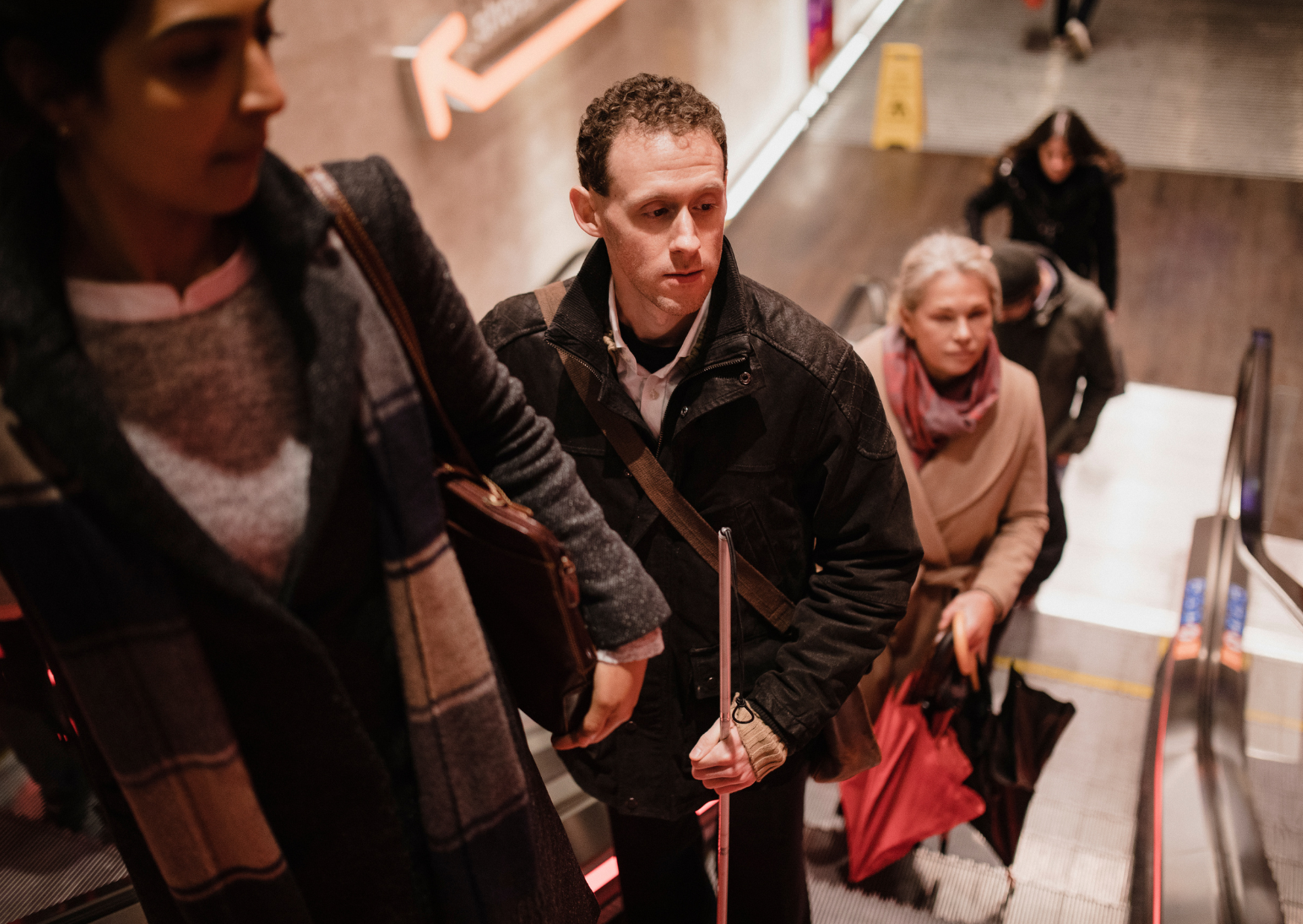
Two soft exceptions are real. If a person with a cane or a parent with a buggy needs room, people tend to give the lane without being asked. If an escalator is nearly empty, nobody cares which side you stand on, as long as you are not hovering at the landing scrolling a phone. The etiquette protects flow. Where flow is not threatened, it relaxes.
Rule of thumb: read the room, obey the sign, copy the locals.
What This Means For You
If you want London to feel easy, treat escalators like roads. Keep right unless overtaking. Keep your bag out of the fast lane. Keep the landing clear. Listen to staff. On long escalators at peaks, be ready for instructions to stand two-abreast. On short ones off-peak, be ready to walk with everyone else. The move that always works is the one you can do without thinking. Right to rest, left to pass.
Do that for two days and you will stop hearing tuts behind you. You will stop getting shoulder-checked at the landing. You will start feeling the city’s speed boost you instead of shove you. London rewards people who learn its small rules. This is one of the smallest, and it buys you the biggest calm.

About the Author: Ruben, co-founder of Gamintraveler.com since 2014, is a seasoned traveler from Spain who has explored over 100 countries since 2009. Known for his extensive travel adventures across South America, Europe, the US, Australia, New Zealand, Asia, and Africa, Ruben combines his passion for adventurous yet sustainable living with his love for cycling, highlighted by his remarkable 5-month bicycle journey from Spain to Norway. He currently resides in Spain, where he continues sharing his travel experiences with his partner, Rachel, and their son, Han.