
Walk into a men’s room at an Italian stadium, Autogrill, or century-old café and you may find a wall-length trough or unpartitioned urinals—three guys shoulder-to-shoulder, eyes forward, nobody bothered. Do the same in a typical U.S. venue and you’ll see privacy dividers, wider spacing, and—if those screens are missing—men bee-lining for a stall. Same human task, two different cultures. The gap isn’t hygiene so much as architecture, norms, and law: Italy optimizes for speed and cleanability in tight spaces; America optimizes for personal space and liability-proof design.
Want More Deep Dives into Everyday European Culture?
– Why Europeans Walk Everywhere (And Americans Should Too)
– How Europeans Actually Afford Living in Cities Without Six-Figure Salaries
– 9 ‘Luxury’ Items in America That Europeans Consider Basic Necessities
What you’re actually seeing—design first, culture second
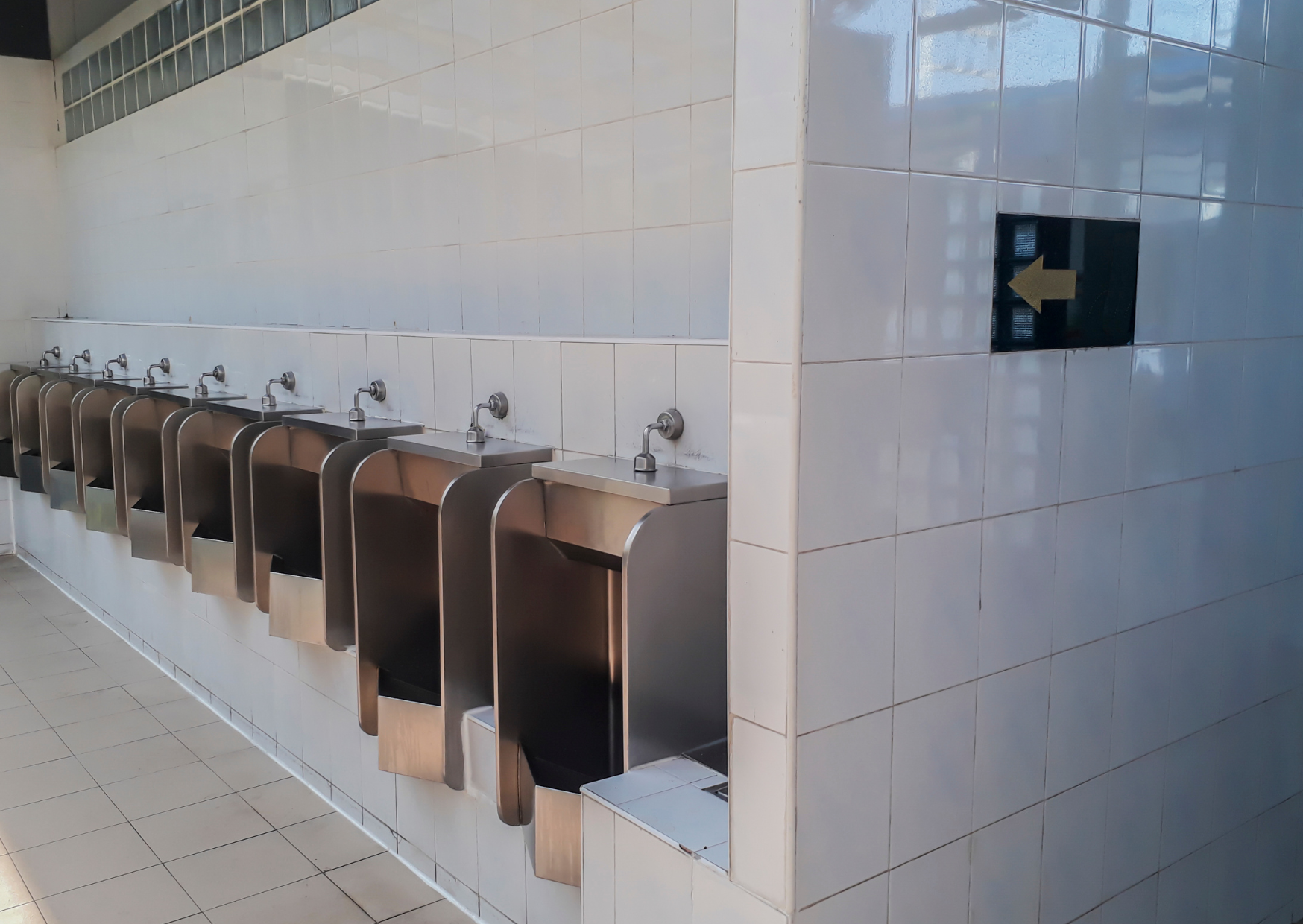
Small rooms — high throughput — easy-to-clean surfaces
Older Italian buildings weren’t drawn around modern restroom footprints. Cafés carved into 19th-century shells, train-station annexes, and Serie A stadiums built or refurbished decades ago all share a constraint: not much square footage for fixtures. The design solution is practical: unpartitioned urinals or continuous troughs that fit more users per linear meter, minimize corners, and hose down fast. The “together” part isn’t about bravado; it’s the byproduct of tight rooms that must move a crowd—espresso break, halftime, or autostrada rush.
Why the U.S. expects shields—even when the code doesn’t
Privacy norm — litigation aversion — family-friendly optics
American men are socialized into a “don’t-perceive me” bathroom norm. Screens enforce that expectation, even where building codes don’t strictly require partitions. Venue operators add them anyway because they reduce complaints, signal propriety for family crowds, and—frankly—look liability-aware. Over time, that hardware becomes the culture: no screens feels wrong, so stalls get overused and urinals go empty. Italy starts from the inverse: no screen feels normal in purely male spaces, and nobody thinks a trough implies low standards if the room is clean and ventilated.
The Mediterranean “distance” setting
Closer personal space — task, not ritual — don’t make it a moment
Southern Europe runs a bit closer in public life—on sidewalks, in queues, at the bar. Bathrooms reflect the same calibration. The rule isn’t “intimacy”; it’s efficiency. Get in, face forward, no commentary, out. If buddies enter together, any chat happens on the way in or out, not at the fixture. Americans often read the lack of partitions as intimacy; Italians read it as “we have a line to move.” Different defaults, same outcome: no drama when everyone follows the script.
Hygiene is not the casualty you think
Fewer seams — fast flush-down — staff clean cycles
Unpartitioned setups can be easier to sanitize: fewer edges and joints to trap grime, quicker power-wash cycles, and full-height tile that tolerates strong cleaners. Troughs and simple bowls let staff flush, spray, squeegee—done. That said, Italy also has the full modern spectrum—new airports, malls, and premium restaurants often do have partitions and private stalls. The point is design trade-offs, not “one country cares, the other doesn’t.” If a room smells rough, it’s a cleaning schedule issue, not a philosophical one.
Where the “pee together” design is common—and where it isn’t
Stadiums & arenas — train/rest stops — heritage cafés
You’ll most often find shared, no-screen setups in mass-throughput venues—football grounds, lower-tier arenas, Autogrill/service areas, older bars that haven’t renovated since the last league promotion. You’ll least often find them in new builds, airport lounges, upmarket restaurants, and business hotels, where partitions or full cubicles are now standard. In short: the more a space screams crowd control or historic footprint, the more likely you’ll see side-by-side.
A century of plumbing packed into small footprints
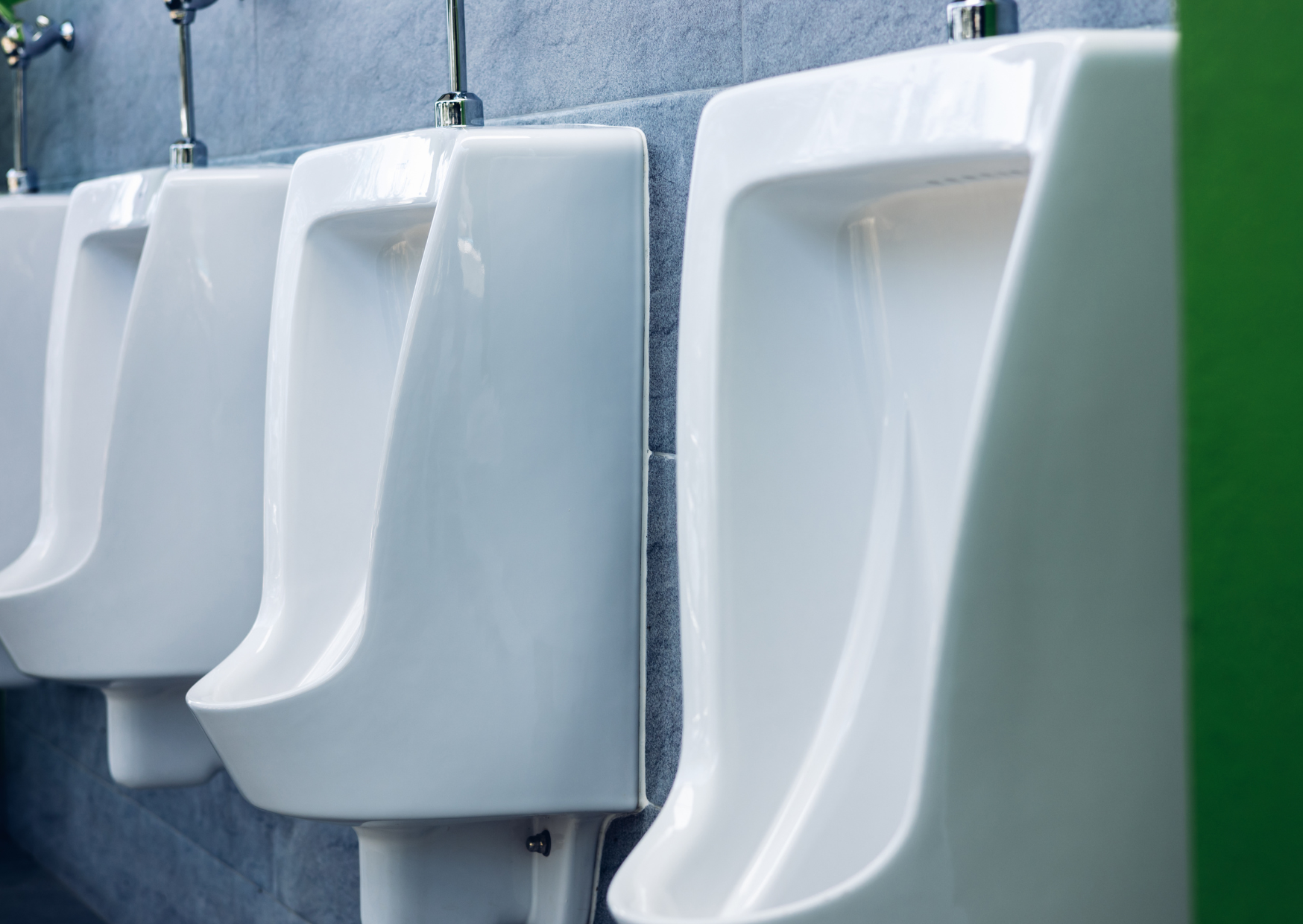
Legacy shells — retrofits, not rebuilds — water closets vs. urinals
Much of Italy uses retrofitted cores rather than gut-rebuilds. The bathroom logic follows: compact water closets for #2 behind doors; urinals or troughs for speed on the men’s side. Partition posts require depth and anchoring many rooms don’t have; troughs deliver capacity without structural fuss. Americans expect private everything because post-war construction in the U.S. made space cheap—suburban stadiums and highway stops got roomy restrooms and thus privacy hardware became baseline.
The social code—what’s okay, what isn’t
Eyes forward — no commentary — stall if unsure
Italian etiquette is remarkably consistent: no eye contact, no talking to strangers, no phones out, move along. If you need privacy for any reason—shy bladder, first time with a trough—use a stall. Nobody cares, nobody clocks your choice, and there’s no merit badge for “joining the line of sight.” What will get you side-eye: lingering, loud jokes, filming, or cutting the queue when a venue posts a single shared line for all fixtures.
Gender, safety, and the modern shift
More unisex singles — more partitions in new builds — safety by design
Across Italy you’ll now see unisex single-occupancy rooms labeled Toilette alongside traditional M/F rooms—especially in galleries, coworks, and cafes that rebuilt recently. Where women share space with men, operators default to fully enclosed cubicles for everyone; partitions or troughs are for men-only rooms. Large complexes—airports, designer outlets, new stadiums—have moved toward privacy-forward layouts anyway: it reduces complaints and fits global expectations without unraveling the speed advantage.
American discomfort decoded—without judging it
Eye-line anxiety — “code of the stall” — learned caution
U.S. men internalize a micro-ritual: one urinal gap, use a stall if proximity feels tight, and avoid chatter. That script grew from wide rooms and ubiquitous partitions; when those props vanish, the body hesitates. It’s not immaturity—it’s conditioning. Flip the context and you’ll see the reverse: Italians in a U.S. restroom with floor-to-ceiling luxury stalls sometimes laugh at the fortress vibe for such a quick task. Both reactions make perfect sense once you consider what each culture built first.
Throughput math: why troughs survive in 2025
Halftime constraints — per-minute capacity — maintenance simplicity
Stadium planners obsess over peak-minute demand—how many men must finish in a 12-minute halftime. Troughs and tight urinal lines still beat partitioned layouts on raw throughput and room turnover. They’re also cheaper to fix: one continuous drain, fewer parts to break, fast to sanitize. As long as legacy concourses and lower-tier venues need to clear queues fast, the unpartitioned option will keep showing up alongside modern, privacy-forward rooms.
Clean vs. comfortable—two different dials
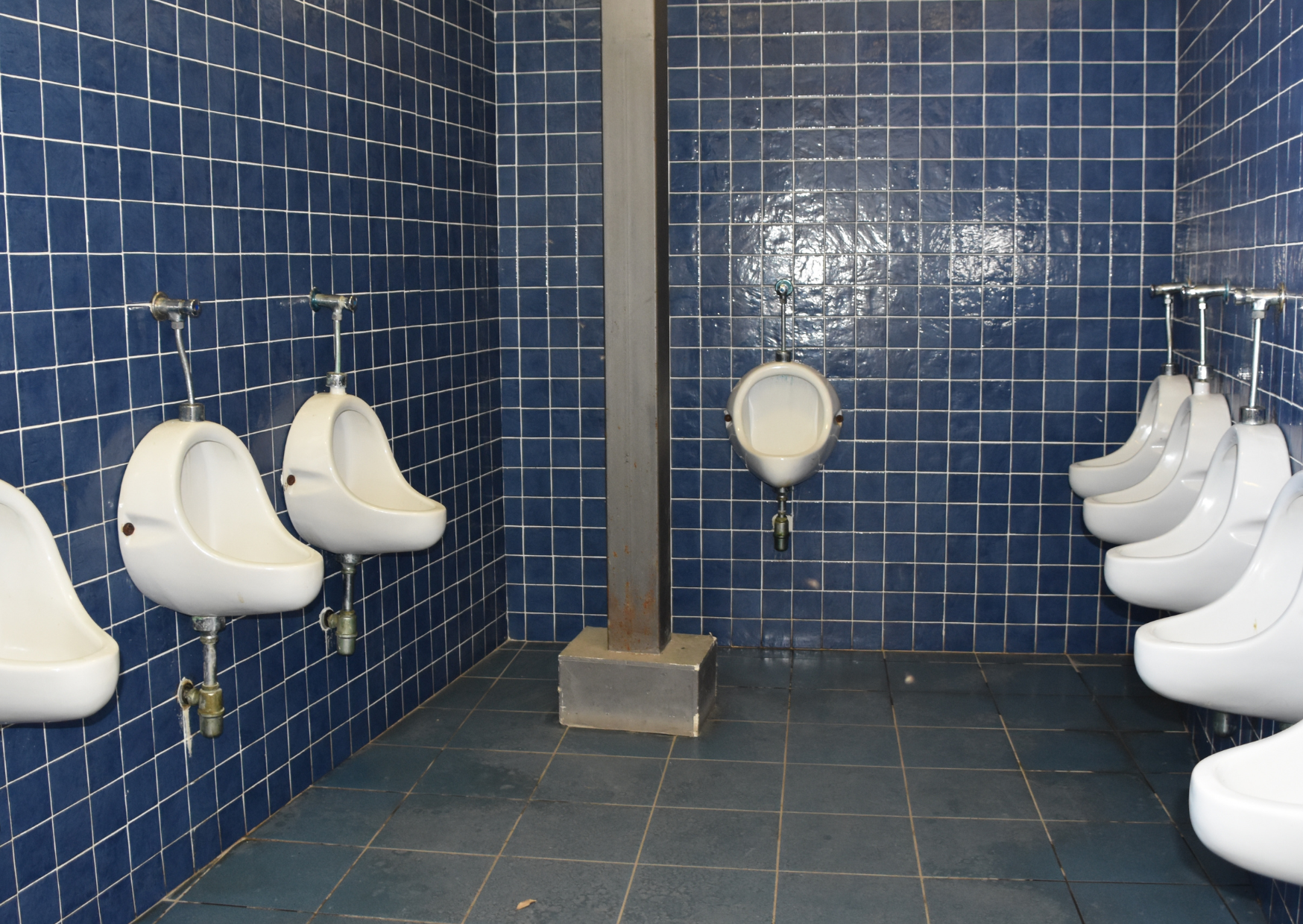
Sanitation schedule — airflow — perception gap
A spotless unpartitioned room can feel less comfortable to a U.S. visitor than a mildly dingy room with screens—because comfort is about privacy signals, not surface reality. Flip it around: an Italian in a super clean U.S. bathroom might feel silly entering a floor-to-ceiling cubicle to do a 20-second task. If you separate sanitation (are staff doing their job?) from signals (does it look private?), you’ll navigate both systems with less stress.
History matters—conscription, squads, and shared facilities
Team sports — military barracks until 2004 — locker-room normalization
Generations of Italian men grew up with team locker rooms, school gyms, and—until 2004—conscription for many, all of which normalized shared, no-nonsense facilities. That early exposure sets a default: function over ceremony in same-sex bathrooms. In the U.S., where many schools added privacy screens earlier and conscription ended decades ago, the baseline slanted toward individual space. Neither path is morally superior; they just yield different reactions to the same porcelain reality.
When Italians absolutely want privacy
#2 is behind a door — medical needs — bidet culture in homes
Nobody is performing stoicism. For anything beyond a quick urinal visit, Italians use a water closet (often labeled WC)—fully enclosed, lockable. In homes, the bidet culture reinforces a different hygiene rhythm: the private, thorough routine happens at home; outside, speed and surface cleanliness are the goal. If you need medication, catheters, or longer time, head straight to a stall; staff understand and will prioritize accessibility if you ask.
What to do as a visitor—simple playbook
Scan, choose, commit — aim for a wall spot — carry tissues
- Scan first. If it’s a trough, pick a gap; if urinals, leave one space if there’s room; if not, take the next open—no apology needed.
- Choose privacy if you want it. Stalls are for anyone; use one without drama.
- Commit and go. Eyes forward, no phone, no talking unless with a friend and even then keep it brief.
- Bring a pocket pack of tissues—not every room stocks paper generously; air dryers are common.
- Wash, move. Sinks can be right in the corridor in micro-cafés. Don’t block them. The slowest part of an Italian restroom should be the espresso you return to, not you.
Myths to drop so you stop misreading the room
“It’s unsanitary by definition.” Cleanliness depends on staff cycles, not partitions.
“Italians are showing off.” No—it’s a task; speed equals respect for the queue.
“Every bathroom is like this.” Not even close; new builds mirror global privacy trends.
“Only Italy does this.” You’ll see similar setups in Germany, the Netherlands, the U.K. (older stadiums)—anywhere throughput or historic footprints rule.
The quiet forces that are changing Italian bathrooms
New builds = more partitions — tourism optics — accessibility standards
Tourism volume and accessibility upgrades are nudging layouts toward enclosed cubicles, better wayfinding, and family rooms. Airports and designer outlets already match international expectations; major clubs continue renovating concourses to blend capacity with privacy. You’ll still meet a trough at a provincial derby; you’ll likely find screens at the next high-speed rail hub.
If you run a venue—how to avoid culture-clash complaints
Mix formats — signage helps — cleaning cadence is king
- Blend capacity with choice: one trough wall plus a bank of screened urinals and several stalls is the pragmatic mix.
- Say it out loud: simple icons (“urinals →”, “stalls →”) reduce hesitation and shorten dwell time.
- Over-index on cleaning at peaks: people forgive format when floors shine and air moves. The fastest way to lose Americans is sticky tiles; the fastest way to win them is fresh air and dry floors.
How to talk about it without being that guy

Respect the room — read the local — save the jokes for outside
It’s fine to feel awkward your first time at a trough. It’s not fine to comment on bodies, film, or treat the design as a spectacle while people are using it. If you want to debrief with friends, wait until you’re out. The grown-up take: “Different design, same job. I used a stall.” Done.
Bottom line—two operating systems, both valid
Italy optimizes flow — America optimizes privacy — you choose your lane
Put simply: Italy built for tight rooms and fast turnover; America built for space and signals. Once you see the logic, the discomfort fades. Use what suits you—trough or stall—keep the line moving, wash your hands, and go back to the good part of the day. If you stop expecting your norm to show up everywhere, you’ll notice something Italians figured out a long time ago: most social friction disappears when design and etiquette do their quiet work—and everyone else gets their espresso while it’s still hot.

About the Author: Ruben, co-founder of Gamintraveler.com since 2014, is a seasoned traveler from Spain who has explored over 100 countries since 2009. Known for his extensive travel adventures across South America, Europe, the US, Australia, New Zealand, Asia, and Africa, Ruben combines his passion for adventurous yet sustainable living with his love for cycling, highlighted by his remarkable 5-month bicycle journey from Spain to Norway. He currently resides in Spain, where he continues sharing his travel experiences with his partner, Rachel, and their son, Han.